Why Do Flagship Phones Cost So Much?
technology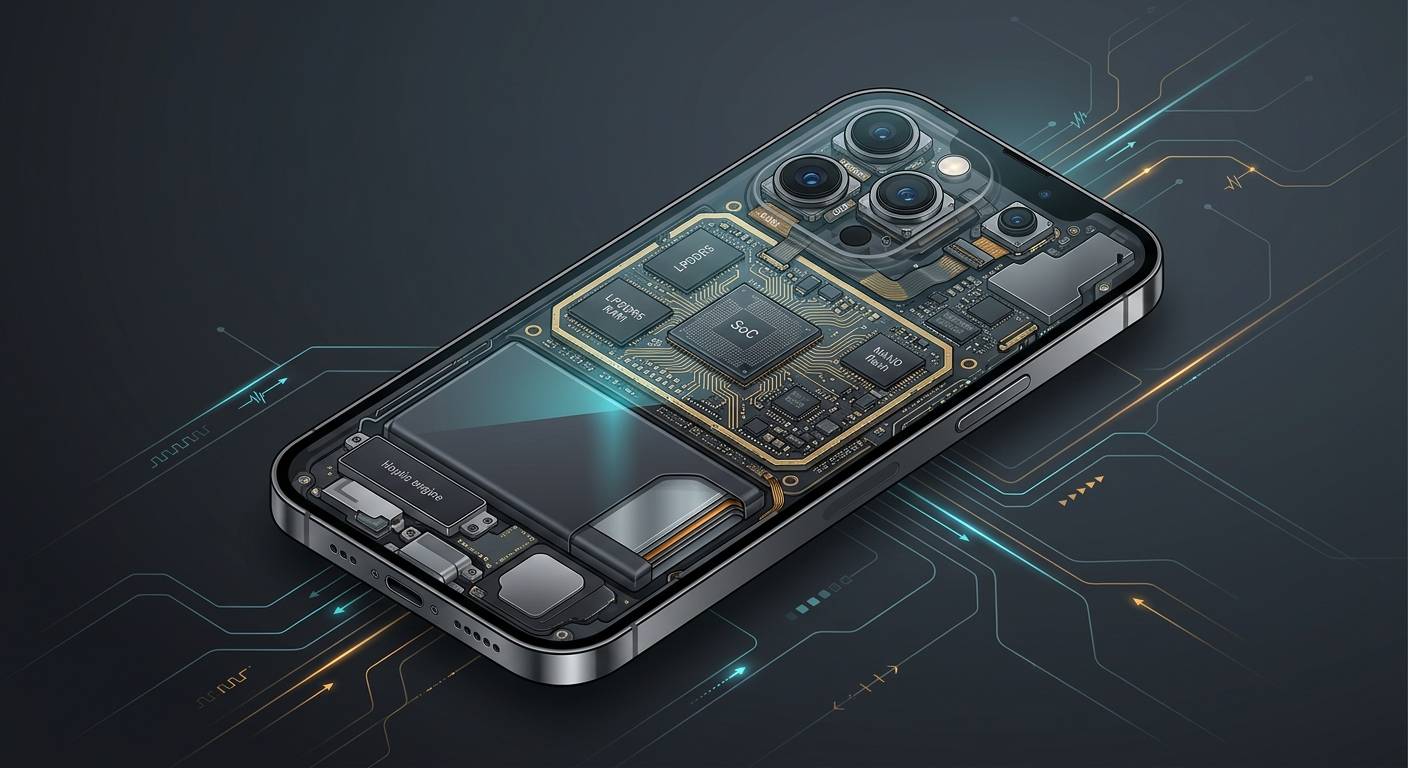
The ultimate engineering challenge isn't making smartphones smarter. It's fitting more intelligence into something that still fits in your pocket.
Look closely at a flagship smartphone from a few years ago alongside the latest model. On the surface, very little seems to have changed. You still see a glass screen, a metal frame, a battery, and a few camera lenses on the back. Many people assume that means the price must keep climbing, but the real story is more complicated.
Flagship phones can feel expensive even when starting prices have stayed surprisingly steady. The insides have gotten far more sophisticated. Parts alone still do not explain the number on the box. To see what you are really paying for, you have to look at the silicon, the glass, and the business strategies behind them.
The iPhone Isn't Just Getting More Expensive
There is a massive contrast between how a modern phone looks and how it is built. On the outside, it is a familiar metal rectangle. On the inside, it has become a masterpiece of micro-engineering.
We expect our phones to do things that were impossible a decade ago. They must edit high-definition video instantly. They must connect to satellites in emergencies. They must run complex software models right in our hands. Even if a phone still "looks like a phone," the sophistication required to build it has soared. That internal evolution helps explain why a flagship still commands a premium, even when the entry price has not jumped every year.
The Cost of the Chip
The brain of your phone is the processor. Today, these chips are more powerful than many desktop computers. To make them faster and more efficient, engineers build them on an incredibly small scale. They squeeze billions of tiny electrical switches, called transistors, onto a slice of silicon the size of a fingernail.
Why does this matter? When transistors are smaller, electricity travels shorter distances. This makes the phone faster and saves battery life. But designing these microscopic circuits is incredibly expensive. Manufacturers must build highly specialized, clean-room factories that cost billions of dollars to construct. Each new generation of chips requires massive development fees before the first processor is ever printed.
Today's chips do not just run apps. They contain a dedicated NPU (neural processing unit), which is a specialized processor built to handle artificial intelligence tasks like voice recognition and image matching. They also contain hardware to handle heavy 3D graphics and process photos instantly.
How much does a processor cost to make? Exact manufacturing costs are closely guarded secrets. However, industry teardowns and analyst models estimate that a flagship processor now costs over one hundred dollars. This is a massive jump from chips of the past, making the brain of the phone one of its most expensive parts.
The Camera System Is Becoming a Computer
We often think of a phone camera as a simple lens and a digital sensor. In a modern phone, the camera is closer to a software-defined imaging system.
When you press the capture button, the phone does not just snap a single photo. The camera lens lets in light, and the sensor records it. But that raw data immediately goes through a complex journey:
- The Lens & Sensor: Capture raw light and detail.
- The ISP: The raw data flows to the ISP (image signal processor), a custom hardware engine that cleans up noise and adjusts color.
- The Neural Processor: The NPU analyzes the shapes and faces in the frame.
- Computational Photography: The software instantly blends multiple frames taken at different exposure levels.
- The Final Photo: A single, balanced image is produced in a fraction of a second.
This process is called computational photography. To make this possible, manufacturers must use larger physical sensors to capture more light. They also build mechanical stabilization systems to prevent blurry pictures when your hands shake. Features like high-end raw video and Night mode require massive processing power. You are not just paying for glass lenses; you are paying for an advanced computer vision platform.
Displays Are Expensive
The display is the part of the phone you interact with every second. Today's premium phones use OLED (organic light-emitting diode display) panels. Unlike older screens, OLED pixels produce their own light. This means the screen can turn off individual pixels to show true black, which looks beautiful and saves battery power.
Modern screens also use LTPO (low-temperature polycrystalline oxide). This is a display technology that lets refresh rates change automatically to save power. If you are looking at a still photo, the screen slows down to refresh only once per second. If you play a fast-paced game, it speeds up to refresh 120 times per second for smooth motion.
Manufacturing these screens is highly complex. Making large, bright displays with high pixel density and perfect color accuracy requires extreme precision. If a single speck of dust ruins a panel during production, it must be thrown away. Suppliers charge high prices to cover the cost of these strict manufacturing standards.
The Materials Are Changing
To make premium phones feel worth their price, companies have changed the materials they use. Over the years, the iPhone has evolved from aluminum to stainless steel, and now to titanium.
Titanium is lighter and stronger than stainless steel. However, it is also much more expensive to buy. It is harder to cut, shape, and polish, which wears down factory machinery much faster.
Does a premium metal make your daily phone experience better? It makes the device lighter in your hand and more resistant to drops. But it is also a design choice. Premium materials help justify a high price tag in a market where consumers want their expensive devices to look and feel luxury.
5G and RF Hardware
Inside your phone is a highly complex radio station. Most users never think about the hardware that connects them to the world. Your phone contains a cellular modem, transceivers, power amplifiers, and custom antennas.
It must connect to multiple 5G bands, high-speed Wi-Fi networks, Bluetooth accessories, GPS satellites, and payment systems. Every new wireless standard adds physical parts to the phone. It also requires companies to pay licensing fees for wireless patents. This invisible radio system adds constant, unavoidable costs to the manufacturing bill.
AI Is Adding Another Layer of Hardware
Artificial intelligence is the newest factor driving up hardware costs. To run AI features on your device rather than sending your private data to a distant cloud server, your phone needs massive local power.
This means phones need more RAM (random access memory) so they can keep AI models ready in the background. They need faster memory speeds so the processor can get answers instantly. They also need larger neural processors and improved thermal systems to keep the device cool under heavy workloads. All of this extra hardware increases the physical cost of building the device.
But Are Components Really the Main Reason?
It is easy to focus only on the cost of the physical parts inside the box. But the retail price of a phone is not simply the cost of its components added together.
When you buy a phone, you are paying for a massive global operation. The retail price must cover:
- Research and Development: Designing custom parts years before they are built.
- Software Engineering: Writing, updating, and securing the operating system.
- Logistics: Shipping millions of heavy glass devices safely around the world.
- Marketing and Retail: Designing stores, training staff, and running advertising campaigns.
- Support and Warranties: Fixing broken screens and replacing faulty batteries.
- Profit Margins: Giving the company the funds to invest in future technology and satisfy investors.
The Hidden Cost: Research and Development
Designing custom technology is a massive financial risk. For years, phone brands bought off-the-shelf parts from other suppliers. Today, Apple designs its own custom processors, graphics units, neural engines, and camera sensors.
By designing its own silicon, Apple reduces its dependence on other chip companies. This custom work lets them match their hardware perfectly to their software. But building these chip design teams takes years of work and billions of dollars in salaries. These massive engineering costs must be paid back through the retail price of the phones.
The AI Era Could Make Phones Even More Expensive
We are entering an era where phones are becoming personal AI companions. In the future, your phone might act more like a pocket-sized supercomputer that happens to make phone calls.
To support these features, future phones may require even more memory, larger batteries, and custom cooling structures. As hardware demands grow, component costs are likely to rise with them. AI capability could become the biggest driver of smartphone prices in the coming decade.
Are iPhones Actually Getting More Expensive?
It is widely believed that iPhones get more expensive every single year. But if we look closely at historical pricing, the truth is more nuanced.
While the absolute highest-end models have climbed in price, the starting price for the standard iPhone has remained remarkably flat for several years. Apple has achieved this by keeping standard models at a consistent price while introducing more expensive "Pro" and "Pro Max" tiers to attract buyers who want the best technology.
Comparison of iPhone Starting MSRPs (US Dollars)
US unlocked launch prices for the lowest storage tier at release. Pro and Pro Max are separate premium tiers: Pro held at $999 for years while Pro Max sat $100-$200 higher.
| Model Year / Release | Standard | Pro | Pro Max |
|---|---|---|---|
| 2007 (Original iPhone) | $499 * | - | - |
| 2017 (iPhone X) | - | $999 | - |
| 2018 (iPhone XS / XS Max) | - | $999 | $1,099 |
| 2019 (iPhone 11 / Pro / Pro Max) | $699 | $999 | $1,099 |
| 2020 (iPhone 12 / Pro / Pro Max) | $799 | $999 | $1,099 |
| 2021 (iPhone 13 / Pro / Pro Max) | $799 | $999 | $1,099 |
| 2022 (iPhone 14 / Pro / Pro Max) | $799 | $999 | $1,099 |
| 2023 (iPhone 15 / Pro / Pro Max) | $799 | $999 | $1,199 |
| 2024 (iPhone 16 / Pro / Pro Max) | $799 | $999 | $1,199 |
| 2025 (iPhone 17 / Pro / Pro Max) | $799 | $1,099 * | $1,199 |
Important Price Caveats:
- 2007: The original iPhone's $499 starting price required a multi-year AT&T contract, so it is not directly comparable to today's unlocked Apple retail MSRP.
- Pro (middle column): Stayed at $999 from the iPhone X (2017) through the iPhone 16 Pro (2024). With the iPhone 17 Pro (2025), it rose to $1,099 when Apple made 256GB the entry storage and dropped the 128GB option.
- Pro Max (right column): The large premium model started at $1,099 with the iPhone XS Max (2018) and stayed there through the iPhone 14 Pro Max (2022), then rose to $1,199 from the iPhone 15 Pro Max (2023) through the iPhone 17 Pro Max (2025). Those figures are for Pro Max only, not the Pro models shown at $999.
These figures show that Apple has held the standard model's starting price at $799 for many years, and held the Pro floor at $999 until 2025. Instead of raising every tier every year, it has steered buyers toward higher-priced Pro and Pro Max models.
Where Does Your Money Actually Go?
When you hand over your money for a premium smartphone, how is that cost divided? Based on industry analysis and teardown models, here is an estimate of how the retail price of a flagship phone is distributed:
- Core Components (Estimated 35% - 45%): The screen, custom chips, cameras, battery, and metal frame.
- Research & Development (Estimated 15% - 20%): Designing custom chips, testing new hardware, and developing software.
- Logistics & Assembly (Estimated 10%): Factory labor, international shipping, and packaging.
- Marketing & Sales (Estimated 10%): Advertising, physical retail stores, and support networks.
- Operating Margin & Taxes (Estimated 20% - 25%): Company profits, regional taxes, and retail partner fees.
Conclusion
When you buy a flagship smartphone, you are not simply buying a slightly better version of last year's device. You are buying a pocket-sized computer packed with billions of transistors, custom processors, sophisticated camera systems, high-speed wireless radios, advanced displays, and increasingly powerful AI capabilities.
But technology alone doesn't explain the price.
Behind that device is a massive engineering effort involving semiconductor design, software development, camera science, battery technology, manufacturing, supply chains, logistics, and years of research and development. Companies are also competing to make these devices thinner, faster, brighter, smarter, and more capable while maintaining the reliability consumers expect.
That creates an interesting paradox: the smartphone may look familiar, but the technology inside it is evolving at an extraordinary pace. Starting prices can stay flat for years while the product itself keeps getting harder to build.
The ultimate engineering challenge isn't making smartphones smarter. It's fitting more intelligence into something that still fits in your pocket.
And as smartphones evolve from simple communication devices into powerful AI computers, the technology inside our pockets will keep changing, and AI hardware may yet be what finally pushes the price tag higher.
Subscribe to Apogee Log
Get deep-tech intelligence updates and featured analytical reports delivered to your inbox.