The Technology Powering FIFA World Cup 2026
technology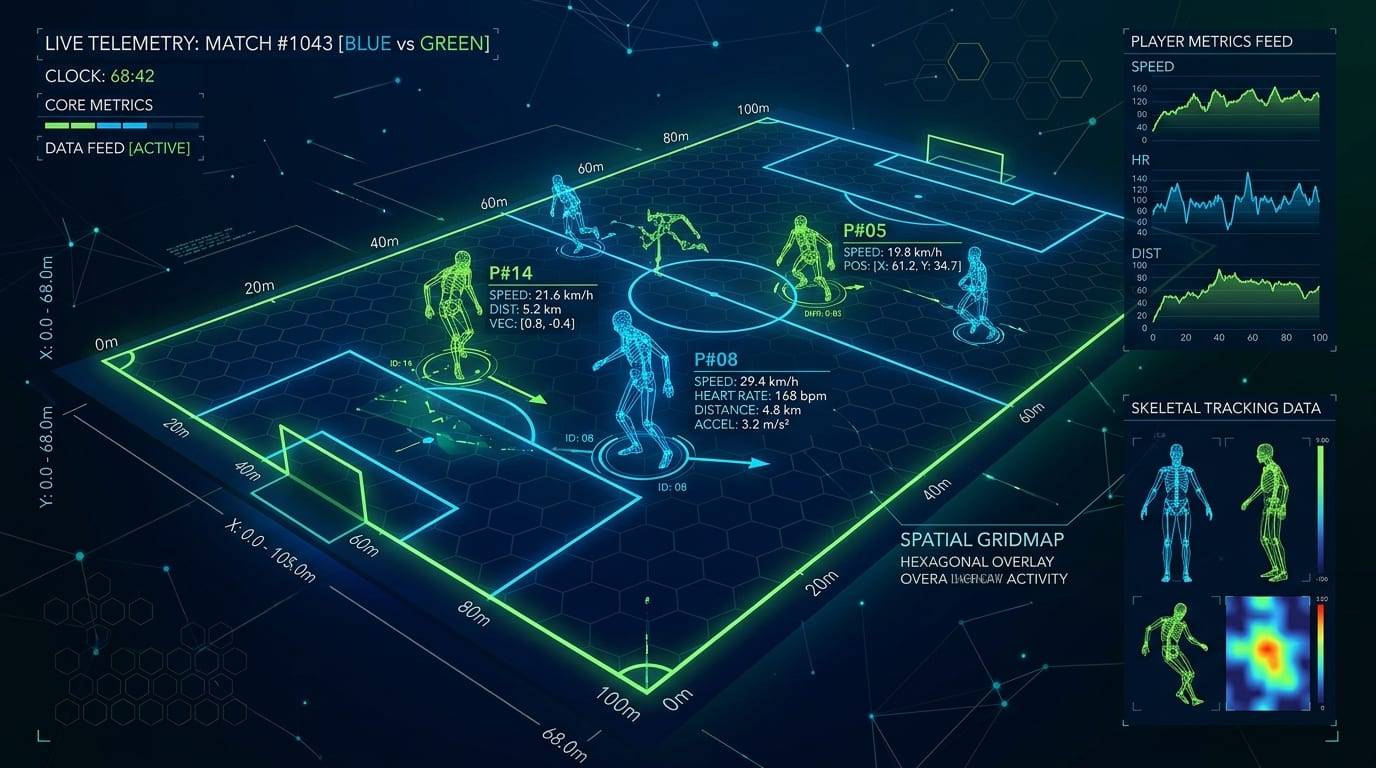
The 2026 World Cup spans three countries and 48 teams. FIFA is stacking cameras, sensors, AI, and digital twins to keep refereeing, broadcasts, and team analysis working at that scale.
The 2026 World Cup will stretch across the United States, Canada, and Mexico: 48 teams, 104 matches, and 16 host cities. That is a lot of moving parts. Behind the goals and the broadcasts sits a quieter layer of cameras, sensors, AI systems, and cloud infrastructure keeping officiating, security, transport, and fan experiences in sync across three countries.
Who Provides What
The tournament infrastructure relies on several specialized technical partners, each delivering distinct hardware and software components:
- Hawk-Eye Innovations (a Sony company): Responsible for ball-tracking systems, including goal-line technology, Video Assistant Referee (VAR) support, out-of-bounds detection, and semi-automated offside tracking. These operations are managed partly through the Football Technology Centre, a joint venture between FIFA and Hawk-Eye.
- Lenovo: As the Official Technology Partner of FIFA, the company provides the foundational AI infrastructure. This includes generating three-dimensional (3D) player models, stabilizing referee body cameras, powering the Football AI Pro analysis tool, and operating the centralized command center. Lenovo also supplies digital twin models of the venues, spectator navigation systems, and in-stadium television networks.
- Adidas and KINEXON: Collaborated to develop the high-performance match ball, which contains a specialized spatial motion sensor.
- Hisense: Supplies the high-definition display screens utilized inside the centralized VAR review rooms.
- Host Broadcast Services (HBS): Directs all international broadcast operations from the primary International Broadcast Centre (IBC) based in Dallas.
- Globant: Develops and maintains the official FIFA mobile application, manages upgrades for the FIFA+ streaming platform, and builds customized fan engagement systems.
- Immersiv.io: Powers the interactive 3D digital viewer tool for fans.
Goal-Line Technology
Determining whether a ball has completely crossed the goal line remains one of the most critical aspects of officiating. To achieve this, each stadium is equipped with a dedicated array of high-speed cameras focused on the goal mouth. These cameras capture high-frame-rate video to reconstruct the exact spatial position of the ball in three dimensions.
- Instant Verification: If the entirety of the ball crosses the goal line, an encrypted radio signal is sent to the head referee's wristwatch, triggering a vibration and visual alert in less than one second.
- Historical Accuracy: Hawk-Eye has provided this specific technology to FIFA since 2014, maintaining a proven accuracy rate exceeding 99.9 percent.
- Out-of-Bounds Detection: For 2026, this optical tracking works in tandem with internal ball sensors to determine if the ball went out of play along the touchlines or goal lines prior to a scoring sequence, utilizing automated 3D reconstruction.
Semi-Automated Offside
Semi-Automated Offside Technology (SAOT) utilizes an array of 16 optical tracking cameras mounted beneath the stadium roof. These cameras operate in real time to capture highly detailed movement data:
- Skeletal Mapping: The system tracks 29 separate skeletal points on each player's body, alongside the ball's position, 50 times per second. This generates more than 150 million data points over the course of a 90-minute match.
- Instant Alerts: In the 2026 tournament, when a player is in an offside position by a margin greater than approximately 10 centimeters, the assistant referee receives an immediate audio notification. This allows officials to raise the flag without waiting for a lengthy manual review.
- New Visual Angles: The system now generates virtual line-of-sight reconstructions, allowing officials and broadcasters to view the play directly from the goalkeeper's perspective.
- Technical Limitations: Despite its precision, SAOT can encounter difficulties during highly congested goal-mouth scrambles, when players are flat on the pitch, or when crucial physical points are obscured from camera views.
The Connected Match Ball
The tournament will feature the Adidas Trionda, a match ball containing a highly sophisticated tracking sensor package:
- High-Frequency Recording: Developed alongside KINEXON, the sensor operates at 500 hertz, transmitting spatial coordinates 500 times per second.
- Impact Timing: By registering the exact microsecond the ball is struck, the sensor provides the precise kick-point data required to make accurate offside calculations. It can also identify subtle changes in acceleration to confirm headers, deflections, or handballs.
- Physical Integrity: The central sensor is suspended by an internal suspension system with balanced counterweights, ensuring the ball's flight path, bounce, and aerodynamic properties remain completely unaffected.
- Power Requirements: The internal components require wireless induction charging prior to kickoff. A 90-minute charge provides roughly six hours of active operational battery life. The consumer version of this connected match ball retails for approximately $170.
Three-Dimensional Player Scans
Prior to the start of the tournament, all estimated 1,248 squad players undergo a brief body-scanning procedure. Lenovo converts these physical scans into detailed 3D digital player models.
These digital representations replace the generic stick-figure animations used in previous tournaments for offside reviews and broadcast graphics. By combining these models with the real-time tracking data used for SAOT, broadcasters can generate virtual camera angles that are physically impossible to capture with traditional lenses, such as overhead bird's-eye views, behind-the-goal perspectives, and isolated tactical angles.
Referee Body Cameras
In a World Cup first, on-field referees will wear headset-mounted cameras to deliver a first-person perspective of the match, known as Referee View. This technology is deployed globally following successful trial runs at the 2025 Club World Cup.
- Real-Time Stabilization: To make the footage watchable for television viewers, Lenovo's built-in AI software reduces rapid head-movement vibration and motion blur by up to roughly 50 percent in real time.
- Communication Channels: Referees utilize specialized earpieces to receive automated SAOT alerts and talk directly to the VAR hub. Additionally, some head referees will be equipped with microphones to explain final VAR decisions directly to stadium spectators and television audiences.
Football AI Pro
To assist team preparation, FIFA and Lenovo are introducing Football AI Pro, a generative analytical platform built on specialized sports learning models.
- Unified Taxonomy: The tool relies on FIFA's Football Language, a standardized technical framework that organizes and classifies match events into distinct categories, such as ball recovery, pressing, defensive lines, and goalkeeper distribution.
- Natural Language Queries: Analysts can submit conversational text questions to retrieve instant video clips, tactical charts, or 3D animations instead of sorting through traditional, static PDF match reports.
- Equal Resource Access: All 48 competing nations receive identical access to this cloud-based platform. To maintain fair play, teams are strictly prohibited from using the software during active matches; it is designed solely for pre-match preparation and post-match evaluation.
Performance Tracking Vests
Separated from the official officiating tools, players wear Electronic Performance and Tracking System (EPTS) devices under their match jerseys:
- Biometric Monitoring: These GPS-enabled vests collect continuous metrics on total distance covered, top speeds, sprint frequencies, and heart-rate zones.
- Workload Management: Coaching staff monitor this live telemetry on sideline tablets to detect fatigue levels and mitigate soft-tissue injury risks, which is highly critical during compressed tournament schedules.
- Supplier Landscape: National federations select and fund these systems independently. Prominent options include Catapult (utilized by teams like Brazil) and STATSports (acquired by Sony in 2025). High-tier enterprise packages cost between $20,000 and $40,000 annually, while entry-level individual packages start near $180 per player per year.
- Parallel Analysis: Some wealthy federations use independent commercial AI tools (such as Google Gemini) to parse physical fitness and tactical telemetry. These external systems remain distinct from FIFA's official, unified platforms.
The Tournament Command Center
Overseeing the entire 16-venue network is Lenovo's Intelligent Command Center located in Miami.
- Unified Dashboard: This central hub aggregates real-time metrics across all locations, tracking spectator gate flows, public transit schedules, broadcast equipment status, and local weather patterns.
- Digital Twin Simulation: The command center utilizes virtual replicas of all 16 stadiums. These 3D digital twins simulate physical bottlenecks and assist security staff in optimizing crowd control.
- Scale of Deployment: To support operations, Lenovo has deployed more than 200 technical engineers and 17,000 hardware devices across base camps, training grounds, and match venues.
Broadcast and Fan Platforms
The media pipeline is anchored by the 45,000-square-meter International Broadcast Centre in Dallas, which routes video signals around the globe.
- Low-Latency Delivery: Specialized local servers distribute live video feeds to over 1,000 digital displays within host stadiums and fan zones, keeping transmission lag below five seconds.
- Immersive 3D Experience: Developed by Immersiv.io, this fan platform allows users to manipulate a virtual 3D pitch on their mobile screens. Fans can switch between traditional broadcast feeds, high-angle tactical views, or individual player-tracking cameras.
- Personalization Engine: Globant's updated FIFA application combines individual user preferences with live tournament statistics to deliver customized match alerts and high-definition video streaming.
Google and FIFA Tools Compared
While FIFA provides unified platforms to ensure fair operational standards, commercial entities offer parallel consumer experiences:
- Official FIFA Platforms: Systems like Football AI Pro and the official mobile application are designed to provide equal access, standardized metrics, and direct data integration for all participating teams and official fan channels.
- Private Team Partnerships: Individual federations can sign private technical partnerships. For example, Argentina uses Google Gemini to run customized biometric and tactical simulations, representing a private resource layer separate from FIFA's standard provisions.
Costs and Estimates
While FIFA does not disclose total tournament-wide expenditures, historical installations offer baseline estimates:
- Stadium Infrastructure: Setting up Hawk-Eye goal-line technology is estimated to cost between $200,000 and $320,000 per venue, excluding ongoing maintenance and specialized staff overhead.
- Optical Camera Arrays: The 16-camera SAOT setup, combined with localized high-speed server racks, represents a multimillion-dollar capital investment across the 16 host arenas.
- Performance Monitoring: High-tier telemetry systems add tens of thousands of dollars to individual team budgets, creating a disparity between highly funded federations and smaller soccer associations.
Benefits and Trade-offs
The massive tech integration presents clear advantages alongside significant challenges:
- Operational Benefits:
- Accelerated officiating decisions that reduce stop-play delays.
- Enhanced player safety by flagging offside situations early, preventing collision-prone late play.
- Equal access to standardized physical and tactical data via Football AI Pro.
- High-fidelity, interactive viewing options for global broadcast audiences.
- Operational Trade-offs:
- High reliance on a single primary vendor (Hawk-Eye) for vital officiating determinations.
- Continued public skepticism regarding automated decision-making and sensor calibration.
- Potential resource gaps, as wealthy federations supplement standard FIFA tools with proprietary analytical partnerships.
Officials Still Decide
Despite the extensive automation deployed throughout the tournament, final authority rests with the human officiating crew. Artificial intelligence and sensor networks serve as support mechanisms, providing objective spatial data to eliminate obvious human errors. The head referee and the VAR team retain the responsibility to interpret subjective plays, such as whether an offside player is actively obstructing an opponent's line of sight or attempting to play the ball.
A New Tournament Standard
The 2026 World Cup represents a milestone in the integration of sports and technology. By combining high-frequency physical sensors with real-time AI modeling, FIFA is setting a new structural standard for international athletics. This unified technical framework will likely serve as the blueprint for future multi-city, multi-nation sporting events, demonstrating how massive datasets can be managed to improve competition, scheduling, and global fan engagement.
Subscribe to Apogee Log
Get deep-tech intelligence updates and featured analytical reports delivered to your inbox.