Is AI Making Humans Dumb? Why Smarter Machines Could Mean Weaker Minds
Artificial Intelligence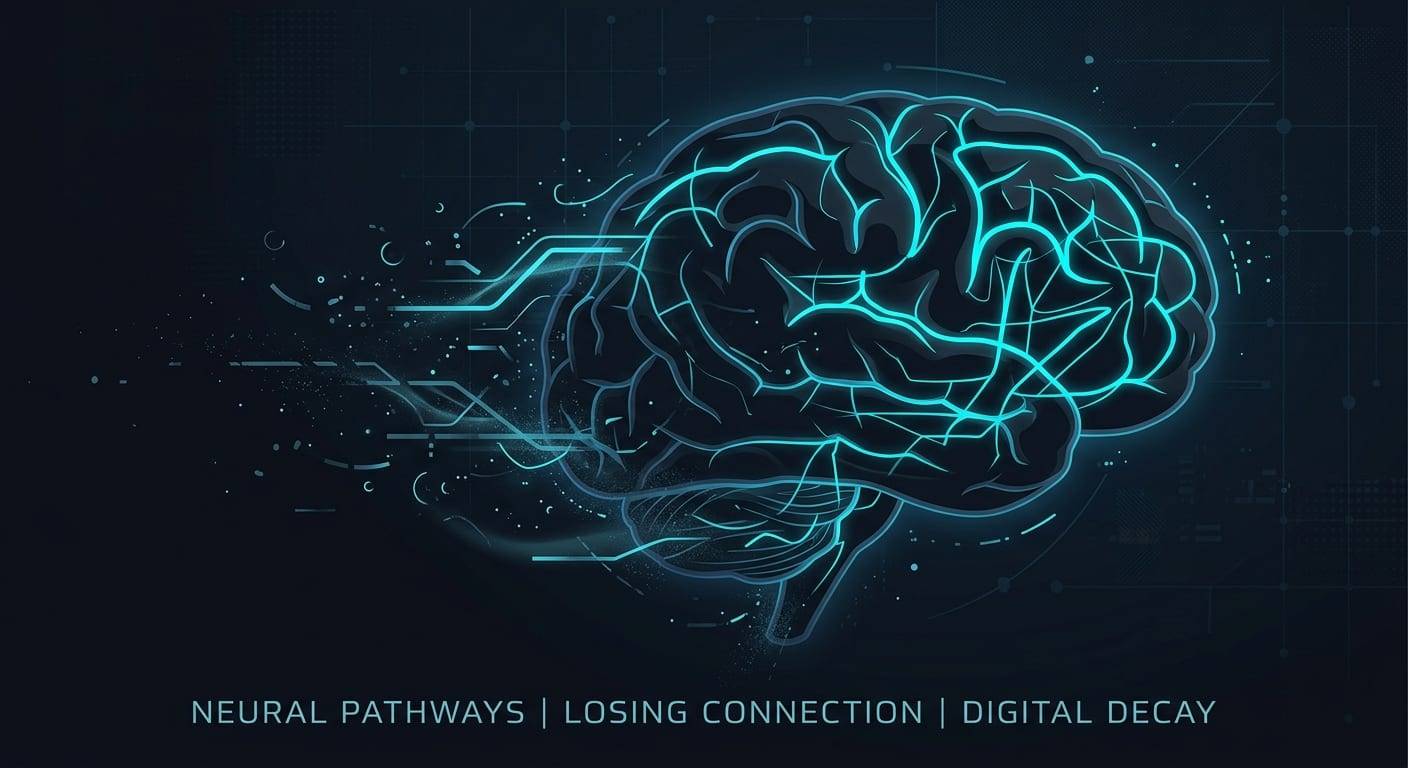
As we outsource our thinking, writing, and problem-solving to artificial intelligence, are we setting ourselves up for cognitive decline? We explore the neuroscience of mental outsourcing and how to stay sharp in an automated world.
The Planet of the Apes Warning
In Planet of the Apes, humanity loses its place at the top of the intellectual hierarchy while another species rises to dominance. The films attribute that fall to a pandemic and the collapse of civilization, not to laziness or dependence on technology. Yet the story offers a powerful metaphor for a question that feels increasingly relevant in the age of AI:
What happens when a society gradually outsources its thinking?
Humanity's downfall doesn't always arrive as a dramatic catastrophe. Sometimes it can be a slow, quiet slide. Tasks become automated. Decisions are delegated. Skills that once required effort are handled by increasingly capable machines. Over time, people may stop practicing the very abilities that made them effective thinkers in the first place.
This is not a prediction of a robot takeover. It is a thought experiment about whether artificial intelligence could weaken human curiosity, creativity, and problem-solving if we rely on it too heavily.
Today, we are standing at a similar crossroads. As large language models make it effortless to write emails, debug code, and summarize books, we have to ask ourselves a difficult question: If we let AI do the heavy mental lifting, what happens to our minds?
What Science Says About Brain Atrophy
When we delegate memory, reasoning, or creative work to technology, scientists call it cognitive offloading. In simple terms, it means letting an external tool do the brainwork so you don't have to.
Our brains are highly efficient, energy-saving organs. They operate on a strict use-it-or-lose-it principle. When we stop challenging our neural pathways, those connections naturally weaken. This is not just a theory—it is a measurable, physical reality.
Several recent studies paint a clear picture of how this offloading affects us:
- The Brain on Autopilot: In a study by Kosmyna and researchers at the MIT Media Lab (~2024–2025), scientists monitored participants' brain activity using EEG while they wrote essays. Those who relied on ChatGPT showed significantly lower connectivity in their frontal-parietal brain networks—the regions responsible for active focus and working memory. Even worse, they had a much weaker memory of what they had just "written" compared to those who wrote unaided.
- The Critical Thinking Gap: Research led by Gerlich at the SBS Swiss Business School (2025) found a direct correlation between frequent AI tool usage and lower critical-thinking scores. The study highlighted cognitive offloading as the primary culprit: when people let AI analyze information for them, their own analytical muscles quickly atrophied.
- The Google Effect on Steroids: In a landmark 2011 study published in Science, researchers Sparrow, Liu, and Wegner discovered that when people expect to have constant access to search engines, they stop remembering facts. Instead, they only remember where to find those facts. AI takes this to an extreme. We no longer just look up information; we outsource the actual synthesis and reasoning.
- Metacognitive Laziness: Collaborative work from UT Austin, Georgia Tech, and Hugging Face has highlighted a phenomenon called metacognitive laziness. While AI tools boost immediate, short-term productivity, they often damage long-term learning. By bypassing the difficult, messy process of struggling with a problem, users fail to build deep, lasting mental models.
For a positive contrast, look at a classic study by Maguire and colleagues published in PNAS (2000). They studied London taxi drivers, who must memorize thousands of streets and landmarks. The researchers found that these drivers had a physically larger hippocampus—the area of the brain associated with spatial memory—than the general public.
Their brains physically adapted because they actively trained them. The warning for our AI-driven era is clear: if active navigation builds the brain, complete outsourcing will inevitably shrink our mental maps.
A World Without School or Work
Imagine a future where artificial intelligence and advanced robotics perform nearly all human labor. We enter a post-scarcity society where the economic need for jobs, degrees, or even money disappears.
While this sounds like a utopia, it introduces a massive psychological challenge. If we do not need to work, what incentive remains to learn?
Why would a teenager spend years practicing algebra, mastering the nuances of essay writing, or learning to code? Why would anyone undergo the grueling process of mastering an instrument or learning a foreign language when an earbud can translate perfectly in real-time?
This is where the threat of cognitive decline becomes a generational issue. It is not that humanity will wake up stupid tomorrow. Rather, it is the gradual erosion of baseline cognitive habits. Over decades, we could transition from a civilization of creators and thinkers to a civilization of passive consumers, entirely dependent on systems we no longer understand.
The Counterargument: Tools of Liberation
To keep this in perspective, we should avoid turning this into an alarmist panic. Moderate use of AI does not automatically ruin your intellect.
Historically, technology has always automated drudgery to help humans move up the skill ladder:
- The printing press did not destroy our memory; it allowed us to build on a collective foundation of knowledge.
- The calculator did not kill mathematics; it freed engineers from manual long division so they could design spaceships.
- A comprehensive meta-analysis conducted in the early 2020s on "digital dementia" found no broad, convincing evidence that general technology use causes permanent cognitive decline.
The critical difference is how we use the tool. The real risk is not that AI exists, but that we might build a relationship of unconditional dependency with it. If we use AI to bypass the learning process entirely rather than to accelerate it, we lose the cognitive foundation required to evaluate the AI's output in the first place.
How to Stay Sharp in an AI World
We do not need to throw away our computers and live in the woods. Instead, we must treat our minds like athletes treat their bodies. Here are three simple, daily habits to keep your cognitive edge:
- Think first, prompt second: Before you ask an AI to write an email, plan a project, or solve a problem, spend five minutes doing it yourself. Outline your thoughts, scribble ideas on paper, or draft a rough version. Establish your own mental baseline before you look at a machine-generated answer.
- Use AI as a sparring partner, not a surrogate brain: Instead of asking AI to write a report for you, write the draft yourself and ask the AI to find gaps in your logic, challenge your assumptions, or suggest counterarguments. Use it to sharpen your thinking, not replace it.
- Protect your unassisted practices: Keep doing things the hard way on purpose. Read long-form books without looking at summaries. Write by hand. Solve puzzles. Practice coding or writing without autocomplete tools. Think of these activities as resistance training for your brain.
AI can be an incredible partner for human curiosity, but only if we keep our own curiosity alive. The future does not belong to those who let machines do all the thinking—it belongs to those who use machines to think deeper.
- ai Archived2026.06.28
In the Age of AI, How Do You Prove You're Human?
As AI agents gain the ability to mimic human browsing behavior perfectly, the classic tests we use to verify our identity are failing. We explore the emerging cryptographic, behavioral, and biometric solutions designed to save the trusted web.
Subscribe to Apogee Log
Get deep-tech intelligence updates and featured analytical reports delivered to your inbox.