Japan's RV-X Rocket Explained: Design, Engine, Fuel, Cost, and SpaceX Comparison
Space & Aerospace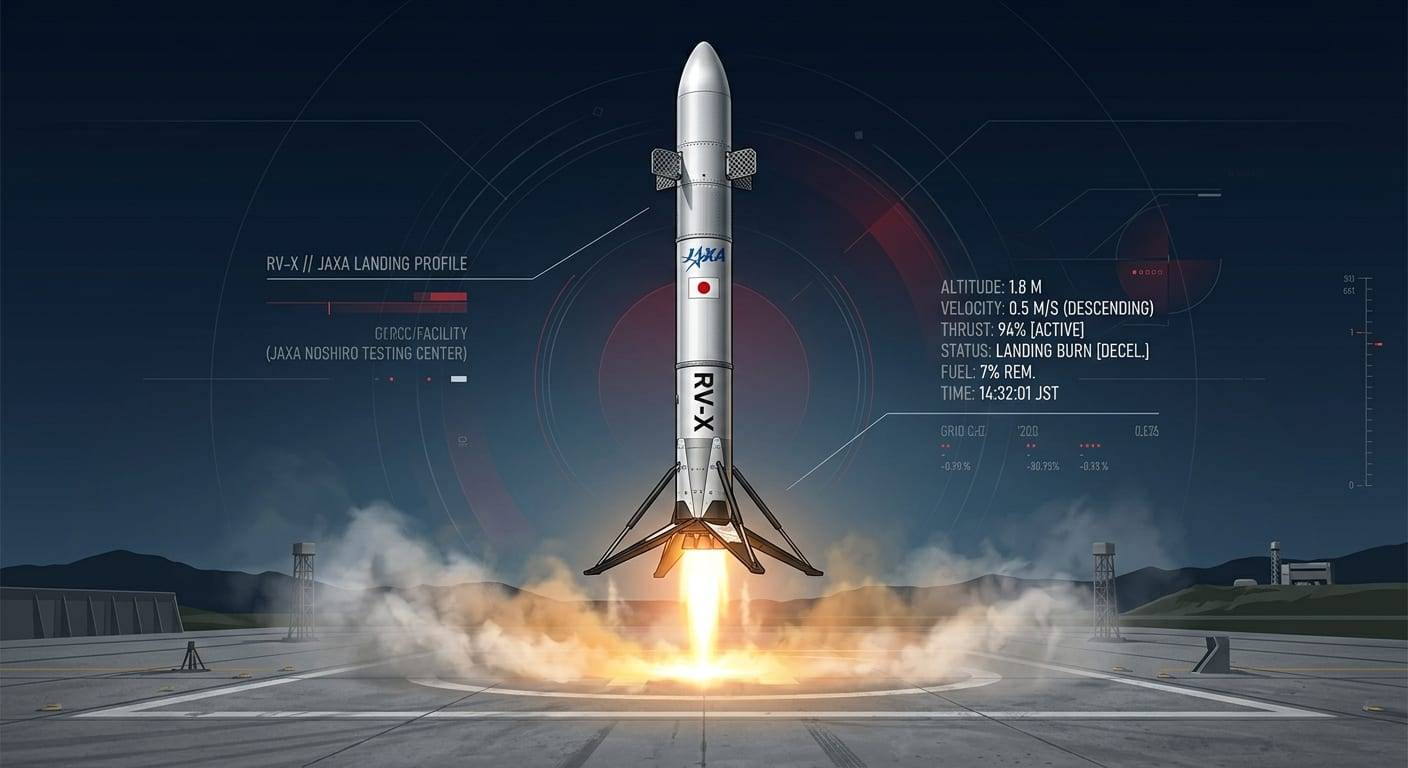
Japan is testing a small experimental vehicle named RV-X to master vertical landings. This crucial stepping stone could bring reusable spaceflight to the country's main launch fleet.
Rockets that can fly more than once are changing the way we reach space. In the past, rockets were single-use machines. They would launch, drop their parts into the ocean, and burn up in the atmosphere. That made every mission expensive. Reusable rockets change the math. By landing and flying again, they lower the cost of every launch, reduce space waste, and allow for much more frequent trips to orbit.
Japan has a long and highly respected history of space exploration. However, the country has not yet built its own reusable rocket like those operated by SpaceX. To close this gap, Japanese engineers created a small test vehicle called RV-X. It is designed to help them learn how to land and reuse rockets safely. JAXA (Japan Aerospace Exploration Agency) recently completed a successful hover-and-land test with the vehicle, a first for Japan's reusable-rocket efforts.
What Is RV-X?
The name RV-X stands for Reusable Vehicle eXperiment. It is a compact test rocket designed by JAXA alongside Mitsubishi Heavy Industries, Japan's largest aerospace company.
RV-X is not a finished commercial rocket. You cannot buy a ticket to ride on it, and it will not carry satellites into orbit. It is a flying laboratory. Its only job is to help engineers gather data on how reusable hardware behaves in flight. The lessons learned from this project will guide the design of Japan's next generation of operational launch vehicles.
RV-X is not working in isolation. Japan is also collaborating with France and Germany on another reusable rocket research project called CALLISTO. Think of RV-X and CALLISTO as close cousins. They are exploring different aspects of the same technology to help Europe and Japan build better rockets.
Design and Dimensions
To picture RV-X, imagine a vehicle about the height of a two-story house. It stands roughly 7 meters (23 feet) tall and measures 1.8 meters (6 feet) wide. When it has no fuel in its tanks, it weighs about 1.8 metric tons, which is roughly equivalent to a large family SUV.
The rocket uses a single-stage design, meaning it does not split into separate pieces during its flight. Its body is highly streamlined, featuring four folding landing legs at the bottom and small steerable fins near the top. This layout is built specifically to keep the vehicle stable during vertical takeoffs and upright landings.
The Rocket Engine
The heart of RV-X is its liquid-fuel rocket engine. In a liquid-propellant engine, fuel and oxygen are stored as chilled liquids in separate tanks. They are pumped into a combustion chamber, mixed together, and ignited to create high-speed exhaust that pushes the rocket upward.
Building a reusable engine is much harder than building a reusable rocket body. During flight, the engine must survive intense heat, violent shaking, and immense pressure. Most traditional rocket engines are worn out after just one use. A reusable engine must be durable enough to survive these forces and reliable enough to shut down and restart perfectly mid-air to cushion the landing. To prove this engine could handle the stress, engineers conducted more than 165 combustion tests on the ground, verifying that the components can withstand repeated use without failing.
What Fuel Does RV-X Use?
RV-X burns a mixture of liquid hydrogen and liquid oxygen.
Rockets need oxygen to burn their fuel, but because there is no air in space, they must carry their own supply. Liquid oxygen serves as this partner. Liquid hydrogen is the fuel itself. It is extremely light and packs a massive amount of energy when ignited.
This combination is highly regarded because it is incredibly clean. When hydrogen and oxygen burn, the only exhaust they produce is water vapor. However, handling these propellants is difficult. They must be kept at temperatures hundreds of degrees below zero to stay in liquid form, requiring highly specialized tanks and plumbing.
How Does RV-X Land?
Landing a rocket vertically is a complex task. The vehicle must perform a series of carefully timed steps to touch down safely:
- The Ascent: The rocket launches vertically, climbing to a pre-set altitude.
- The Turn: On-board computers calculate the descent path back to the landing pad.
- The Descent: The rocket falls back toward the ground, using its small steering fins to stay on course.
- The Landing Burn: Just before touchdown, the engine restarts to slow the descent.
- The Touchdown: The four landing legs deploy, and the rocket gently settles onto the ground.
Engineers use two main types of flight tests to perfect this process. Hover tests involve lifting the rocket a short distance into the air, holding it still, and landing it. Descent tests push the rocket higher, letting it fall freely before restarting the engine to land. Both tests are essential for proving the rocket can steer itself under its own power.
Flight Testing
The testing program for RV-X has been a series of careful, low-risk steps. Most of the flights took place at the Noshiro Rocket Testing Center in northern Japan.
Early tests focused on making sure the engine could throttle up and down smoothly. Later, the team conducted tethered flights where the rocket was attached to safety cables. The major milestone came when RV-X successfully completed its first free-flight hover-and-land test. The rocket rose into the air, hovered steadily, adjusted its position, and touched down safely on its legs. This flight proved that Japan's home-grown guidance software and hardware could successfully control a vertical landing.
Cost
While JAXA has not shared the exact budget for the RV-X program, developing small test vehicles is far cheaper than building full-sized orbital rockets.
The program represents a long-term financial trade-off. Developing reusable technology requires significant spending upfront. However, once mastered, the savings are massive. Instead of building a new multi-million-dollar rocket for every single mission, Japan will only need to pay for fuel and minor maintenance between flights, drastically lowering the cost of reaching space.
How Does It Compare with SpaceX?
To understand Japan's progress, it helps to compare RV-X with SpaceX's reusable program:
- Scale: SpaceX operates at a massive scale. Its Falcon 9 rocket is over 70 meters tall and has landed hundreds of times. RV-X is a 7-meter prototype that does not fly to orbit.
- Maturity: SpaceX is a mature commercial operator launching satellites weekly. Japan is still in the early research and development phase of reusability.
- Approach: SpaceX learned by launching and occasionally crashing full-sized rockets during real missions. JAXA is taking a highly cautious, step-by-step approach with smaller, cheaper test rigs to minimize risk and cost.
While Japan is years behind SpaceX in operational experience, RV-X proves that JAXA is successfully mastering the same foundational skills, such as precise engine throttling and automated landing controls.
Challenges Ahead
Japan faces several major hurdles before it can field a fully reusable orbital rocket:
- Scaling Up: Moving from a 7-meter test vehicle to a massive 60-meter operational rocket introduces massive structural and aerodynamic complications.
- Engine Degradation: Real-world flights expose engines to salty sea air and extreme thermal stress, which can shorten the lifespan of reusable parts.
- Weather Sensitivity: Small test vehicles are easily pushed off course by wind. JAXA must design systems that can land reliably in rough weather.
- Global Competition: With other countries and private firms developing their own reusable boosters, Japan faces pressure to move quickly.
Future Roadmap
The data gathered from RV-X is already shaping Japan's space future. These findings are directly helping the development of the larger CALLISTO project.
Over the next decade, JAXA plans to scale up these technologies. The ultimate goal is to introduce reusable first-stage boosters to Japan's primary launch fleet, potentially as upgrades to the H3 rocket series. While an operational reusable Japanese rocket is still years away, the successful flights of RV-X show that Japan is on the right path.
What to Watch Next
Keep an eye on upcoming joint tests between JAXA, France, and Germany. These flights will push the boundaries of altitude and speed, bringing Japan closer to its dream of sustainable space exploration.
Subscribe to Apogee Log
Get deep-tech intelligence updates and featured analytical reports delivered to your inbox.