In the Age of AI, How Do You Prove You're Human?
Artificial Intelligence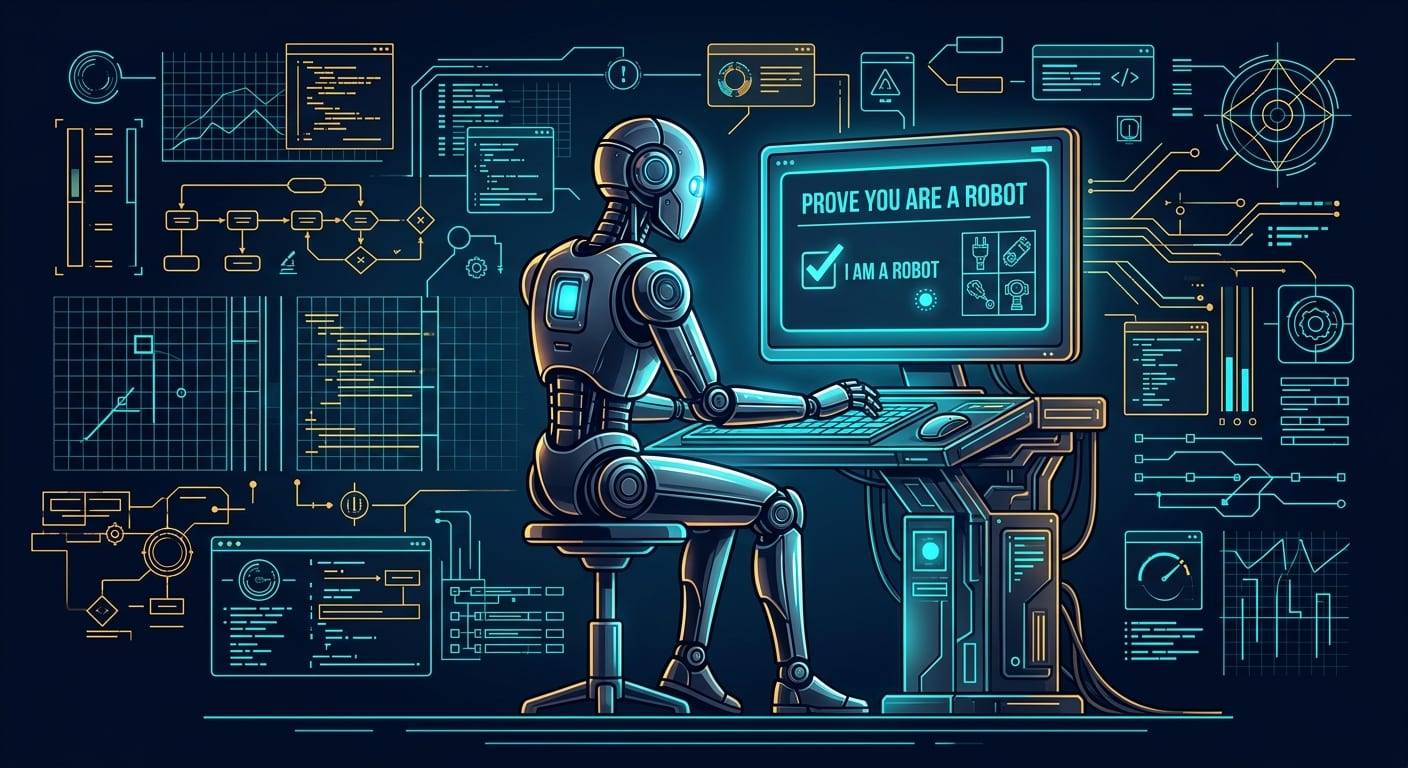
As AI agents gain the ability to mimic human browsing behavior perfectly, the classic tests we use to verify our identity are failing. We explore the emerging cryptographic, behavioral, and biometric solutions designed to save the trusted web.
As AI agents become indistinguishable from people online, the internet may need an entirely new way to verify humanity.
For nearly three decades, a simple, irritating question has guarded the gates of the digital world: 'Are you a robot?' This prompt has appeared on billions of screens worldwide, acting as a digital bouncer protecting websites from automated spam, malicious bots, and system abuse. Yet, as artificial intelligence evolves from a novelty tool into an autonomous force, this decades-old question is becoming nearly impossible to answer with traditional methods.
CAPTCHA Is No Longer Enough
Let's start with a tool everyone recognizes. Since the early days of the web, CAPTCHA (Completely Automated Public Turing test to tell Computers and Humans Apart) has been our primary defense. At first, it relied on distorted text that human eyes could decode but optical character recognition software could not. As computers grew smarter, we transitioned to image-based challenges—identifying traffic lights, crosswalks, or bicycles.
Later came invisible systems like Google's reCAPTCHA and Cloudflare Turnstile, which analyze subtle behavioral cues, browser configurations, and telemetry to verify a user's humanity without active disruption. For roughly two decades, these methods succeeded because they relied on a fundamental gap between human cognitive processing and machine capabilities.
That gap has vanished. Today's multimodal AI models process text, imagery, and behavioral patterns with human-like comprehension. Modern neural networks can easily read distorted text, isolate objects in imagery with pixel-perfect accuracy, and even mimic natural mouse jitter to bypass behavioral checks. When machines can pass these tests faster and more accurately than humans, the foundational assumption that CAPTCHAs separate people from bots is officially broken.
The Rise of AI Agents
The challenge has expanded far beyond simple chatbots. We are entering the era of the AI agent—highly capable software systems designed to act autonomously on behalf of users. Unlike static search tools, these agents can browse websites, compare products across different marketplaces, fill out complex web forms, book travel arrangements, and complete checkout processes with credit cards.
These systems do not merely fetch data; they navigate the web exactly like a person. If an autonomous agent can complete a multi-step purchase or draft a nuanced response on a web forum with the same behavioral profile as a human consumer, it poses a profound philosophical and security question: if AI can complete the exact same tasks as a human browser user, what exactly are we verifying?
The Internet Was Built on an Assumption
The architecture of the modern web relies on an unwritten agreement. For decades, the design assumption for any web platform was simple: Browser → Human. Every login portal, digital checkout, discussion board, voting poll, and ticket vendor was built assuming that a human mind was steering the web browser.
Now, that pipeline has transformed into Browser → AI Agent. This single shift upends the security architecture of the entire internet. If automated agents can simulate authentic human interaction, then every mechanism we use to prevent coordinated voting manipulation, ticket scalping, financial fraud, and automated misinformation becomes dangerously obsolete.
Why CAPTCHA Is Becoming an Arms Race
This does not mean verification systems will vanish overnight. Instead, we are entering a relentless and escalating arms race. The cycle repeats continuously:
- Step 1: Cybersecurity teams develop more complex, invasive challenges to detect non-human activity.
- Step 2: AI researchers train models to solve those new challenges with high accuracy.
- Step 3: The defense mechanisms must become even more complex, resulting in higher friction for actual humans.
- Step 4: The threshold of human frustration is reached, prompting automated workarounds that AI quickly masters.
This circular struggle means that relying on active puzzle-solving to verify humanity is a losing battle. The solution requires moving past active challenges entirely.
How Do We Prove We're Human?
To secure the future web, developers and cryptographers are building alternative verification systems. Several key technologies are emerging to fill the void:
- Behavioral Telemetry: Instead of checking what you solve, systems analyze how you interact. This involves tracking microscopic patterns in mouse trajectories, typing rhythm, phone tilt angles, and touch gestures. Because humans have physical limitations and muscle memory, our physical interactions possess a unique organic signature that is difficult for a digital agent to replicate perfectly.
- Device Trust and Passkeys: This method relies on secure hardware built into modern smartphones and computers. By utilizing built-in cryptographic coprocessors, websites can verify that a session is originating from a legitimate physical device tied to a registered user identity (such as a passkey protected by biometric security), bypassing the browser layer entirely.
- Digital Identity Wallets: A highly secure, privacy-focused option. Instead of uploading sensitive documents like a passport or driver's license to a third-party server, a user's local digital wallet generates a one-time cryptographic proof of identity. The website receives a secure token confirming the user is real and verified, without exposing any personal data.
- Government-Issued Digital IDs: Many nations are piloting centralized digital identity registries.
- The Pros: Highly secure, authoritative, and virtually impossible for automated agents to fake.
- The Cons: Substantial privacy risks, the potential for state-level surveillance, and low global adoption due to varying political and technological infrastructure.
The Privacy Paradox
This technological shift brings us to a complex dilemma: the privacy paradox. Historically, we proved our humanity by revealing almost nothing. Clicking a checkbox required no sharing of personal details, allowing users to remain entirely anonymous while proving they were not malicious scripts.
In the future, verifying that we are human may require us to reveal much more. To convince a website that we are not an AI agent, we might have to surrender continuous biometric telemetry, subject ourselves to hardware-level tracking, or link our web sessions directly to verified physical identity tokens. In attempting to purge malicious bots from the internet, we risk building an omnipresent layer of surveillance that tracks every click, tap, and keystroke.
What Happens to the Anonymous Internet?
If verifying humanity becomes mandatory to access digital services, can the anonymous internet survive? The impact will likely vary depending on the platform:
- Online Forums and Social Media: Anonymity has historically protected free speech, whistleblowers, and open discussion. Forcing identity verification on these platforms could silence vulnerable voices, yet leaving them open could result in platforms being completely overrun by AI-generated campaigns.
- Banking, Shopping, and Ticket Sales: These transactional spaces will likely adopt strict hardware-level trust and cryptographic identity checks to combat automated checkout bots and financial fraud, making human verification highly friction-free but closely tied to physical identity.
- Dating and Community Platforms: Trust is paramount here. These spaces may require optional 'Verified Human' badges, creating a two-tiered system where unverified anonymous users are sequestered from verified individuals.
Conclusion
For nearly thirty years, the internet asked one simple, automated question: 'Are you a robot?'
In the era of highly capable, autonomous AI, that question is no longer sufficient. The challenge of the coming decade will not be stopping the robots, but rather answering a far more complicated question: How do we prove we are human without giving up our privacy?
Looking ahead five years, early signs suggest we will see the total abandonment of active puzzles. Instead, humanity verification will happen silently in the background, driven by a combination of secure device hardware, cryptographic zero-knowledge proofs, and real-time behavioral telemetry. Our digital identity will no longer be proven by what we can solve, but by how we exist in the physical world.
- ai Archived2026.06.13
Is AI Making Humans Dumb? Why Smarter Machines Could Mean Weaker Minds
As we outsource our thinking, writing, and problem-solving to artificial intelligence, are we setting ourselves up for cognitive decline? We explore the neuroscience of mental outsourcing and how to stay sharp in an automated world.
Subscribe to Apogee Log
Get deep-tech intelligence updates and featured analytical reports delivered to your inbox.