Why NASA Wants ISRO on the Moon
Space & Aerospace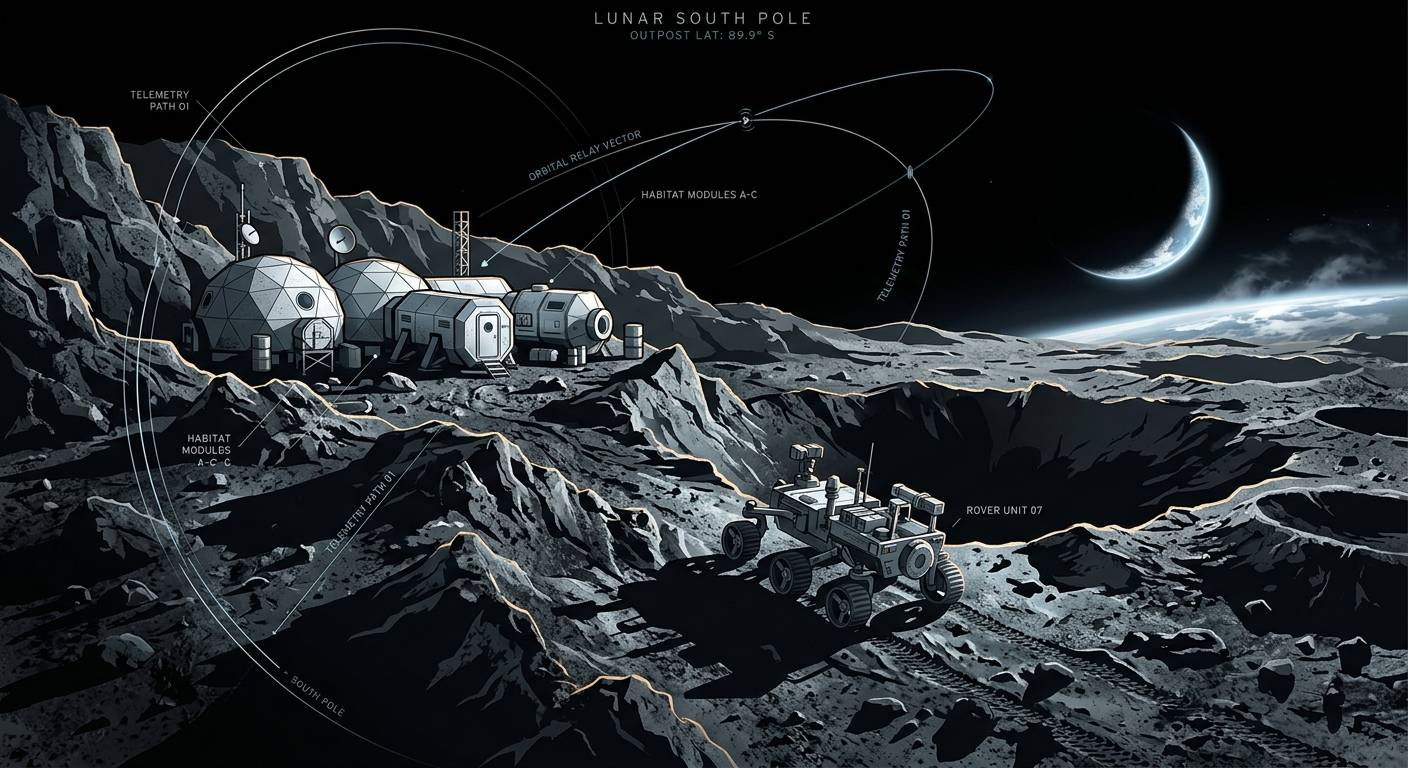
The US space agency recently invited India to help build its permanent lunar outpost. Here is why Washington is looking to New Delhi for critical south-pole support, and what India might bring to the table.
NASA wants India's help to build a home on the Moon. During a diplomatic meeting in Bengaluru, the US space agency (NASA) invited the Indian Space Research Organisation (ISRO) to join its ambitious Moon Base initiative. This is not just a polite political gesture. It is a calculated move that could reshape the future of deep-space exploration. Why does the world's most well-funded space agency want to share its lunar plans with India, and what can ISRO actually bring to the table?
NASA Wants India on the Moon
The invitation became public during the ninth meeting of the India-U.S. Civil Space Joint Working Group (CSJWG). The group gathered at ISRO Headquarters in Bengaluru on August 5 and 6, 2026. High-level representatives, including ISRO Chairman V. Narayanan and U.S. Ambassador to India Sergio Gor, used the meeting to deepen their space alignment.
This discussion builds directly on the Artemis Accords, a set of US-led principles for peaceful lunar and deep-space exploration that India signed in 2023. It also advances technological cooperation under the Transforming the Relationship Utilizing Strategic Technology (TRUST) Initiative, following up on a February 2025 Joint Leaders' Statement. While both countries also agreed to share open scientific data, the standout moment was NASA inviting ISRO into its Moon Base fold. It is a natural next step for two partners currently celebrating the successful 2025 launch of the NASA-ISRO Synthetic Aperture Radar (NISAR) Earth-observation satellite. Still, this is an invitation, not a finished contract, and the specific hardware India might build remains undecided.
This Is Bigger Than Another Moon Mission
To understand why this invitation matters, we have to look at how lunar exploration is changing. For decades, lunar missions followed a simple pattern: launch a spacecraft, land, collect data, and go home. India's recent lunar missions followed this path.
NASA's Moon Base programme is completely different. First announced during the agency's Ignition event on March 24, 2026, Moon Base is a phased effort to build a sustained human presence near the lunar south pole. Rather than quick, isolated visits, the plan is to build lasting infrastructure. NASA envisions this developing through three main stages: early robotic learning, constructing basic infrastructure, and eventually supporting longer-duration human stays. No single country can easily afford or build this alone. International partners are crucial because they can split the burden of building roads, power grids, and habitats, rather than just planting national flags.
Why the Lunar South Pole Matters
The destination for this collaborative effort is the lunar south pole, a region that is incredibly difficult to reach but highly valuable. Deep, permanently shadowed craters sit next to towering peaks that receive nearly constant sunlight.
The shadows are the main attraction. Evidence suggests these dark craters contain pockets of water ice. If astronauts can harvest this ice, they can melt it for drinking water, split it into oxygen for breathing, or refine it into rocket fuel. But operating here is a nightmare. The terrain is rugged, temperatures drop to extremes that can crack metal, and communicating directly with Earth is impossible from inside deep craters. This is why infrastructure is so important: survival requires a network of power, communication, and landing sites.
Why NASA Wants ISRO
NASA is not approaching India out of charity. ISRO has earned its place at the table through practical, budget-conscious engineering.
When India landed its Chandrayaan-3 mission near the lunar south pole in 2023, it did what other well-funded space programmes had failed to do. The agency showed it can navigate the tricky terrain of the southern polar region. Furthermore, ISRO's earlier orbital missions provided valuable scientific data about lunar water, and the country is currently developing its Gaganyaan human spaceflight programme. While Gaganyaan is still in its testing phase and has not yet flown a crewed mission, it is building the domestic technical foundation needed for long-term spaceflight.
Perhaps most importantly, NASA and ISRO already know how to work together. Building and launching the complex NISAR satellite in 2025 proved that these two massive bureaucracies can successfully coordinate on engineering, data sharing, and launch operations.
What Could India Actually Contribute?
Because this is an early-stage diplomatic invitation, we do not know exactly what ISRO will build. However, India's technological strengths point to several potential areas of cooperation.
Lunar Robotics
India has shown it can build small, efficient rovers. ISRO could contribute automated robotic scouts to survey future landing sites, test the soil, or map out roads before heavy human equipment arrives.
Scientific Instruments
Indian scientists have a track record of building reliable, lightweight instruments. ISRO might supply sensors to measure lunar seismic activity, analyze soil chemistry, or monitor the harsh radiation environment at the south pole.
Lunar Resource Exploration
Finding and analyzing water ice is a major priority. India could design specialized drills or sensors to locate ice deposits hidden deep inside dark craters, helping Moon Base planners decide where to set up water-processing stations.
Communications and Navigation
Since the south pole blocks direct signals to Earth, astronauts will need orbital relays. India has extensive experience building and operating communication satellites, meaning ISRO could potentially provide orbiters to relay telemetry and voice data back to Earth.
Human Spaceflight
As India advances its Gaganyaan crewed capsule, the country will develop expertise in life support systems, spacesuits, and astronaut training. Over time, this could lead to Indian astronauts working alongside international crews at the Moon Base, though no flight slots have been scheduled yet.
India Has Already Proven It Can Reach the Moon
India's invitation to join the Moon Base is the result of nearly two decades of steady lunar progress. It did not happen overnight.
The journey began in 2008 with Chandrayaan-1, which carried a NASA instrument that helped confirm the presence of water molecules on the Moon. In 2019, Chandrayaan-2 attempted a soft landing. While the lander crashed, the orbiter remained fully functional, providing high-resolution imagery that helped pave the way for future missions. In 2023, Chandrayaan-3 achieved a textbook soft landing near the south pole, cementing India's reputation as a reliable lunar operator.
From Chandrayaan to a Lunar Base
India's path from its first lunar probe to a seat at the Moon Base table shows a steady rise in capability and international trust.
| Year | Milestone | Why it matters |
|---|---|---|
| 2008 | Chandrayaan-1 | India begins major lunar exploration and helps discover evidence of lunar water molecules. |
| 2019 | Chandrayaan-2 | The landing attempt fails, but the orbiter succeeds, providing extensive orbital operation experience. |
| 2023 | Chandrayaan-3 | Successful landing near the lunar south pole proves India can master difficult lunar operations. |
| 2023 | Artemis Accords | India joins the international framework for peaceful, cooperative lunar exploration. |
| 2025 | NISAR Mission | NASA and ISRO successfully launch their joint satellite, proving they can build complex hardware together. |
| 2026 | Moon Base Invitation | NASA asks ISRO to participate in its permanent lunar outpost programme, elevating the partnership. |
What This Means for India's Space Programme
Joining the Moon Base programme could transform ISRO from a regional space power into a builder of global infrastructure. It gives Indian engineers direct experience with long-term survival technology, deep-space communication networks, and complex international hardware integration.
This partnership also opens doors for India's private aerospace companies. By participating in international bids, local businesses can grow from domestic suppliers into global competitors. In the long run, helping build a shared international base could give India the technical blueprint to eventually pursue its own independent lunar outposts.
What We Still Don't Know
While the political excitement is high, the technical details are entirely blank. Space fans should keep their expectations grounded until formal agreements are signed.
- No agreed hardware: ISRO has not committed to building any specific rover, habitat, or instrument for the Moon Base.
- No budget figures: Neither government has announced how much funding India will dedicate to this joint effort.
- No astronaut commitments: It is highly uncertain whether or when Indian astronauts will fly to the Moon Base.
- No clear timeline: We do not know which phases of the Moon Base programme will include Indian technology.
The Bigger Race for the Moon
The push for a permanent presence on the Moon has a clear geopolitical dimension. While the US and its Artemis partners work on their lunar plans, China is leading a rival effort to build its own international lunar research station. But this is not just a rerun of the Cold War space race. The modern competition is less about who gets there first and more about who can build the most reliable, cost-effective infrastructure. By bringing India into the fold, NASA gains a highly capable ally with a proven ability to deliver results on a tight budget.
Conclusion
For decades, lunar exploration was measured by whether a spacecraft could reach the Moon. The next phase will be measured differently. Can humans build infrastructure that allows them to stay? Chandrayaan showed that India could reach the Moon. The NASA invitation potentially gives ISRO a chance to help decide what humanity does once it gets there.
Subscribe to Apogee Log
Get deep-tech intelligence updates and featured analytical reports delivered to your inbox.