Why Japan Is Targeting Phobos Before Mars
Space & Aerospace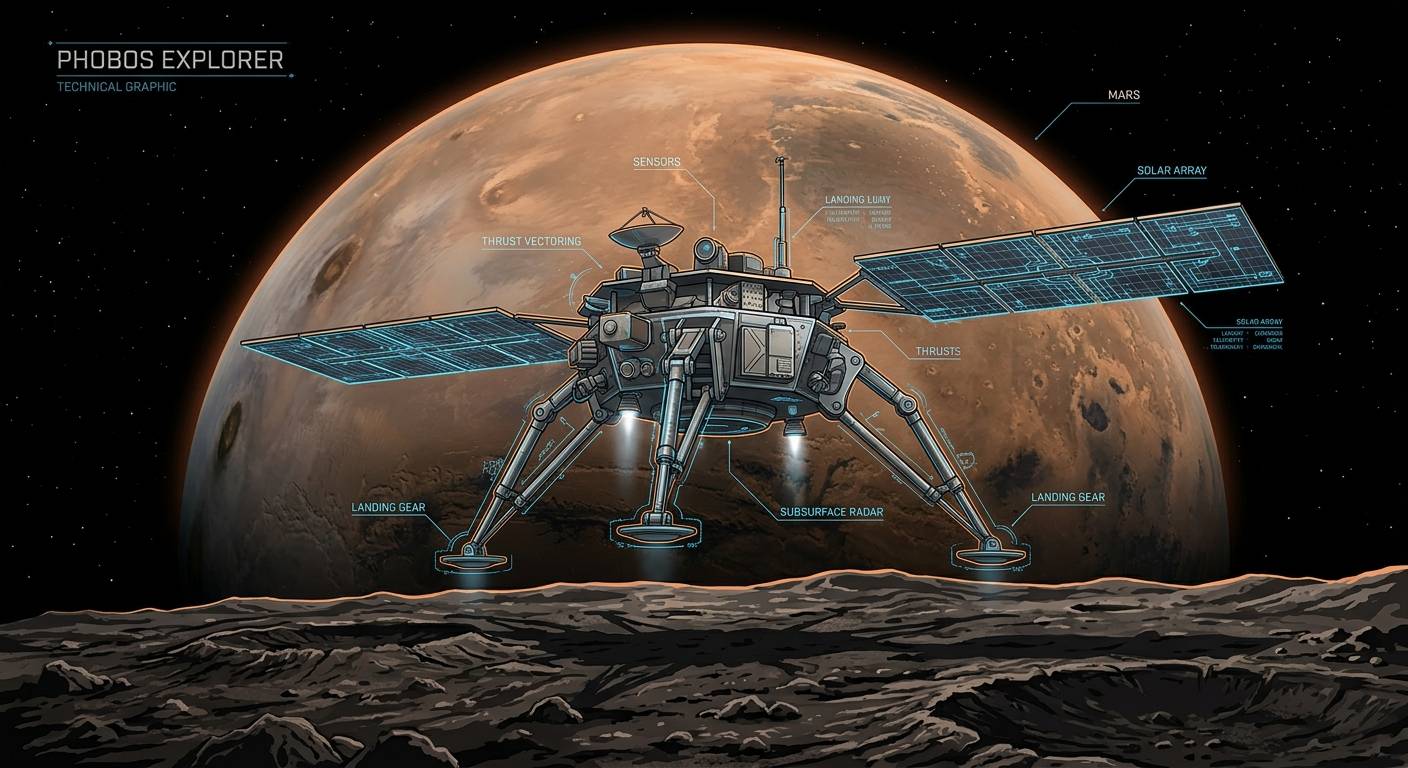
Instead of racing to put boots or heavy treads on the Martian surface, JAXA is taking a clever detour. By targeting Mars' closest moon, the MMX mission aims to steal the secrets of the red planet without fighting its massive gravity well.
Sending a multi-billion-dollar spacecraft to the Mars neighborhood is the ultimate test of engineering, but landing on the red planet itself is a brutal exercise in physics. The Martian atmosphere is thick enough to burn up a spacecraft, yet too thin to slow it down properly, requiring giant heat shields, complex parachutes, and retro-rockets. Instead of fighting this gravity well, the Japan Aerospace Exploration Agency (JAXA) is taking a different route. JAXA plans to bypass Mars' surface entirely to land on Phobos (the larger, closer moon of Mars). By aiming for this tiny satellite, the Martian Moons eXploration (MMX, Japan's mission to Mars' moons) hopes to bring back the first-ever pristine samples from the Martian system. No spacecraft has ever successfully returned a sample from a Martian moon, and Japan is betting its deep-space reputation that Phobos is the key to unlocking the history of Mars itself.
Japan's Next Big Space Gamble
This ambitious detour is the core of Japan's flagship planetary flight. The starting gun is scheduled for 20 October 2026 at 4:41 a.m. Japan Standard Time, when JAXA's H3 (Japan's current flagship launch vehicle) rocket No. 10 is slated to lift off from the Tanegashima Space Center. This launch carries high stakes because the first H3 test flight failed in 2023, forcing JAXA to delay the MMX mission from its original 2024 launch window. Now, Flight 10 must deliver the massive spacecraft into orbit safely to keep the country's space timeline on track. This is not a one-way trip to snap photos. MMX is a massive, multi-year round trip designed to drop a rover, touch down on Phobos, scoop up physical soil, and fly those samples back to Earth by 2031. To understand why JAXA is risk-profiling a moon instead of the main planet, we have to look at what Phobos actually is.
What Exactly Is Phobos?
Phobos is not the clean, glowing sphere we see in Earth's night sky. It is a dark, lumpy, potato-shaped rock measuring roughly 27 by 22 by 18 kilometers, orbiting a mere 6,000 kilometers above the Martian surface. It is accompanied by Deimos (the smaller, farther moon), which orbits much further out. Phobos is so close to Mars that it completes three orbits in a single Martian day, slowly spiraling inward toward an eventual destruction millions of years from now. Scientists still debate where these two oddballs came from. One theory suggests they are simple carbon-rich asteroids captured by Mars' gravity. The other theory points to a massive, ancient collision between Mars and another space rock, suggesting Phobos is the leftover debris clumped together in orbit. This origin debate is the exact reason why a small, lumpy moon is worth a five-year journey.
Why Phobos Matters to Understanding Mars
If Phobos is made of impact debris, its rocks are actually ancient fragments of Mars itself, preserved in a deep-freeze environment for billions of years. Even if Phobos is a captured asteroid, it has spent eons acting as a giant celestial sponge, collecting dust and particles blasted off Mars by asteroid impacts. By studying and returning these surface grains, scientists can peer into the history of Mars' ancient atmosphere and water without the immense challenge of landing a retrieval vehicle on the Martian surface. NASA's Perseverance rover has cached Mars samples on the surface, but those rocks do not have a ride home yet. MMX aims to bypass that queue, delivering Martian history straight to our labs by following a highly coordinated flight plan.
The Mission's Strange Journey
The road to Phobos and back is a long, highly coordinated game of orbital billiards. The spacecraft must survive a year-long deep-space cruise before spending three years conducting science in the Martian system. Here is how JAXA's planned timeline breaks down:
| Planned Date | Milestone | Why it matters |
|---|---|---|
| 20 October 2026 | H3 No. 10 Launch | Lift-off from Tanegashima kicks off the journey. |
| August 2027 | Mars-Orbit Insertion | MMX arrives at Mars and enters a stable orbit. |
| September 2027 | Close Phobos Operations | Science instruments begin high-resolution mapping. |
| Late 2028 or Early 2029 | Idefix Rover Release | The small scout rover drops to test the soil before the main landing. |
| Around 2029 | Sampling Touchdowns | The mothership lands briefly to gather Phobos material. |
| 2029 - 2030 | Deimos Flybys | MMX shifts focus to study the smaller, outer moon from afar. |
| November 2030 | Departure from Mars | The return module fires its engines to head back to Earth. |
| July 2031 | Sample Capsule Recovery | The return capsule lands in the South Australian outback. |
This grueling itinerary is only possible because of how the spacecraft was designed to live and work around Mars.
A Spacecraft That Has to Live at Mars
To survive this half-decade trek, JAXA designed MMX as a three-part modular vehicle with a launch mass of roughly 4,000 to 4,500 kilograms. It consists of a propulsion module to handle the heavy orbital maneuvers, an exploration module packed with scientific cameras, and a return module carrying the capsule that will fly back to Earth. Managing power at Mars is a constant battle because sunlight is less than half as strong as it is at Earth. Instead of using a nuclear radioisotope thermoelectric generator, JAXA opted for lightweight, thin-film solar-panel wings that fold out to catch the dim light. These wings must be exceptionally large to generate enough electricity, and onboard batteries store power to keep systems running during eclipses. JAXA also chose traditional chemical engines over solar-electric propulsion; electric thrusters would have required even larger solar wings, which would risk hitting rocks during a landing and add years to the return trip.
- Power Source: Oversized thin-film solar arrays
- Energy Storage: Onboard lithium-ion batteries
- No Nuclear: Zero radioisotope generators on the mothership
- Propulsion: Chemical thrusters for quick maneuvers and a safer landing profile
Operating this solar-powered system is tricky, but the real test comes when the spacecraft tries to touch down on a world with almost zero gravity.
How Do You Land on a Tiny Moon?
Landing on Phobos is more like docking with a space station than landing on the Moon. Phobos' gravity is roughly a thousand times weaker than Earth's, meaning a 25-kilogram object would weigh only about 15 grams there. If a lander hits the surface too fast, it will simply bounce back into space. To study this bizarre environment before committing the main spacecraft, MMX is carrying Idefix (the small French-German rover MMX will drop on Phobos), developed by the French space agency CNES and the German Aerospace Center DLR. During a landing rehearsal in late 2028 or early 2029, MMX will drop the 25-kilogram rover from a height of about 40 meters. Idefix will tumble to the surface, use a motorized mechanical system to stand itself upright, deploy its small solar panels, and spend over 100 Earth days analyzing the soil. It will beam its data back to Earth using the MMX mothership as a radio relay, remaining on Phobos forever once the main mission is complete.
Once the rover confirms the surface conditions, the main MMX spacecraft will attempt its own short touchdowns. The vehicle will stay on the surface for only about two and a half hours per landing, arriving at local sunrise and leaving before sunset. This quick turnaround keeps the solar-powered lander from freezing during the bitter Phobos night, leaving a narrow 90-minute window to grab the physical samples.
How the Samples Come Home
To ensure scientists get their hands on clean, undisturbed moon dirt, JAXA is employing two distinct sampling systems that must pack at least 10 grams of material into the return capsule.
The collection process relies on two distinct designs:
- C-SMP (Coring Sampler): A robotic arm designed to push a tube more than 2 centimeters deep into the Phobos soil to collect structured layers.
- P-SMP (Pneumatic Sampler): Developed with NASA and Honeybee Robotics, this system sits on a landing leg and uses a quick blast of pressurized nitrogen gas to blow loose surface dust upward into a collection chamber.
Once the collection is done, the robotic arm is planned to transfer both sample canisters into the SRC (Sample Return Capsule, the heat-shielded container that brings Phobos material to Earth), which is roughly 60 centimeters wide. When the spacecraft departs Mars in November 2030, this capsule will be sealed tight. After a year-long cruise back to Earth, the return module will release the capsule to plunge through Earth's atmosphere, aiming for a soft landing under a parachute in the Woomera region of South Australia. Under a joint agreement between Japan and Australia, recovery teams will search the desert, retrieve the container, and ship it to ISAS (Institute of Space and Astronautical Science, JAXA's lab near Tokyo that will open and catalogue the samples). There, in pristine cleanrooms, scientists will open the canisters to search for clues about the birth of the solar system.
Japan Is Quietly Becoming a Planetary-Exploration Power
This ambitious attempt is not a random stroke of luck; it is the culmination of decades of JAXA perfecting the art of low-gravity operations. While NASA specializes in heavy Mars rovers and ESA excels at complex orbital mappers, Japan has quietly carved out a niche in planetary sample returns. JAXA's Hayabusa and Hayabusa2 (Japan's asteroid sample-return missions) successfully brought back dust from the asteroids Itokawa and Ryugu, proving that the agency could navigate, touch, and escape tiny cosmic bodies. More recently, Japan's SLIM (Smart Lander for Investigating Moon, Japan's 2024 lunar lander) demonstrated precision landing technology on the Moon. Although SLIM tipped over on landing, it proved that JAXA could hit a landing zone within a few meters of its target. The upcoming MMX mission on the H3 rocket is the next logical step in this heritage, taking the lessons learned from asteroids and applying them to the gateway of Mars.
Why the Moon Before the Planet
Landing on Mars would be a different kind of triumph. MMX is aiming at a smaller target because that target may hold the story of how the Mars system was built. A few grams from Phobos will not settle whether humans should live on Mars. They could settle what Phobos is, and that is a question nobody has been able to answer from flybys alone.
Subscribe to Apogee Log
Get deep-tech intelligence updates and featured analytical reports delivered to your inbox.