Vikram-1 Launch Explained: Design, Engine, Payload, and Why It Matters
Space & Aerospace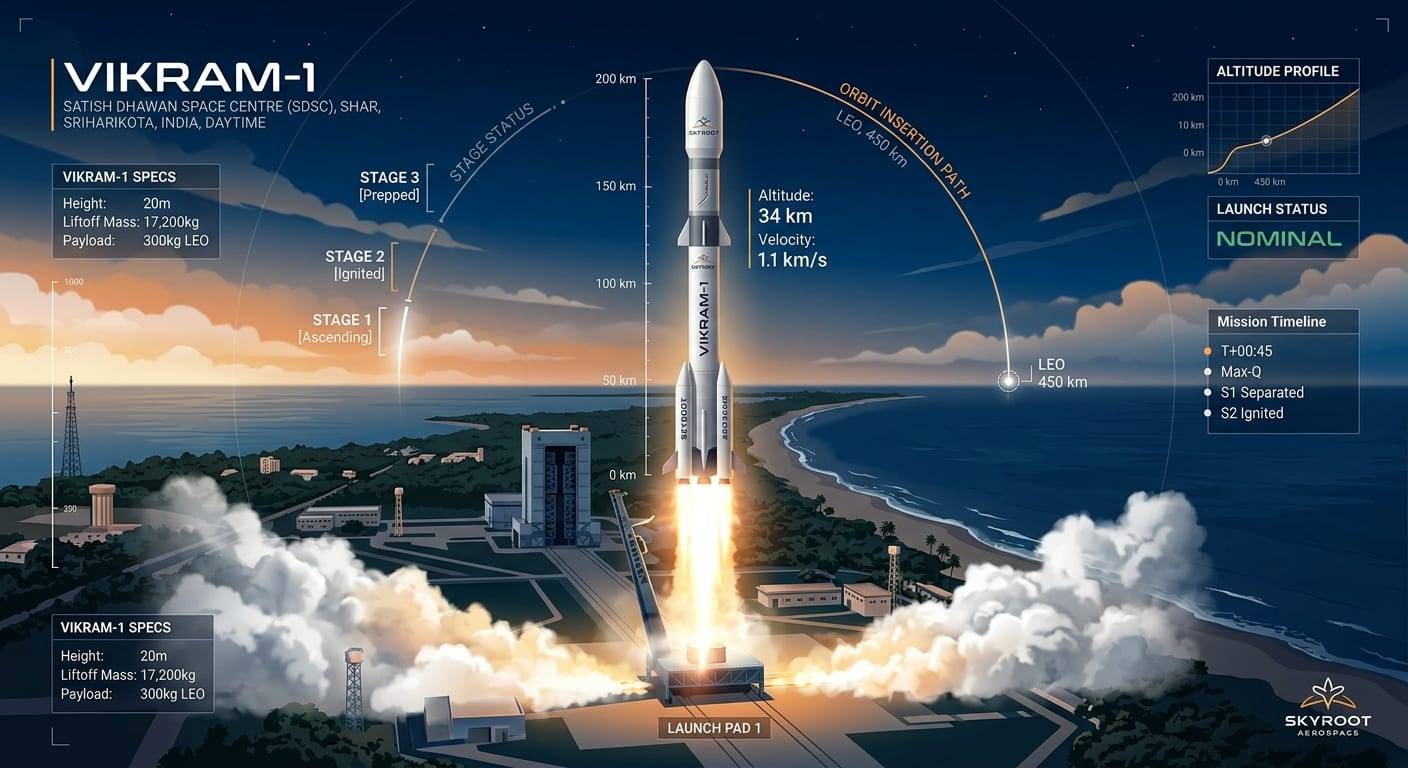
On July 18, 2026, India's first private orbital rocket successfully reached space. Here is a simple breakdown of how Vikram-1 works, what it carried, and why this mission matters.
On July 18, 2026, history was made in the skies over India. A private rocket named Vikram-1 roared to life and successfully reached space. This mission, named Mission Aagaman, launched from the First Launch Pad at the Satish Dhawan Space Centre (SDSC), Sriharikota.
With this flight, India joined a very select group of nations capable of launching private orbital rockets from their own soil. Even more impressive, the rocket succeeded on its very first try.
So how was this sleek new machine designed? How do its engines work, what did it carry into space, and why does this first flight matter for the wider space industry?
What Is Vikram-1?
Vikram-1 is a light-lift rocket built by Skyroot Aerospace, a private space company based in Hyderabad, India. The rocket is named in honor of Dr. Vikram Sarabhai, widely regarded as the founder of India's space program.
The main job of Vikram-1 is to carry small satellites into low Earth orbit (LEO). These are orbits relatively close to Earth, usually a few hundred kilometers high, where most weather, imaging, and communication satellites operate.
One detail is easy to mix up with the company's past work. Back on November 18, 2022, Skyroot launched a smaller rocket called Vikram-S. That was a suborbital flight, which means it went up to the edge of space and came right back down without entering orbit. Vikram-1, however, is a full orbital launcher. It possesses the speed and power to place objects into a stable orbit so they can stay in space.
The Historic Launch (Mission Aagaman)
The historic flight took place on July 18, 2026. At exactly 12:05:30 PM IST, the rocket lifted off into a clear sky. Launch controllers had briefly held the countdown from its original window around 11:30 AM to make final checks, but the wait was short and the launch went flawlessly.
The rocket climbed quickly, shedding its lower stages as they ran out of fuel. Each stage did its job perfectly. Finally, the upper stage placed its payloads into a clean orbit roughly 450 kilometers above the Earth.
Here is how the key moments of Mission Aagaman unfolded:
| Mission Event | Time / Status | What Happened |
|---|---|---|
| Pre-launch Hold | ~11:30 AM IST | Short delay for final systems check |
| Liftoff | 12:05:30 PM IST | Vikram-1 clears the launch pad at SDSC |
| First Stage Separation | Past | First solid booster finishes burning and drops away |
| Second & Third Stages | Past | Middle solid motors fire and separate in sequence |
| Fourth Stage Burn | Past | Liquid engines fire to steer and gain orbital speed |
| Orbit Insertion | Past | Rocket reaches target 450 km low Earth orbit |
| Payload Deployment | Completed | Satellites safely released into space |
Why the Launch Is So Important
For decades, India's space journeys were managed entirely by the government through the Indian Space Research Organisation (ISRO). The successful flight of Vikram-1 on July 18, 2026, changed that picture completely.
First, it was the first private orbital launch from Indian soil. While other companies around the world have built private rockets, very few have succeeded on their very first attempt to reach orbit. Skyroot did exactly that.
Second, this flight shows that India's private space sector has truly arrived. It was supported closely by ISRO and the Indian National Space Promotion and Authorization Center (IN-SPACe), which provided facilities, safety reviews, and final launch clearances. This partnership shows how governments and private businesses can work together to open up space.
Vikram-1 Rocket Specifications
To understand how Vikram-1 works, it helps to look at its size and power. It is designed to be small, agile, and relatively cheap to build and launch.
| Specification | Measurement | Everyday Comparison |
|---|---|---|
| Height | ~24 meters | About as tall as a seven-storey building |
| Diameter | ~1.7 meters | Roughly the width of a small family car |
| Total Mass | ~45,000 kilograms | Equal to about nine adult elephants |
| Payload Capacity | A few hundred kilograms | Can carry a couple of household appliances |
| Number of Stages | 4 Stages | Multi-part rocket to save weight |
| Propulsion Type | Solid fuel (Stages 1-3) + Liquid fuel (Stage 4) | High power at the start, high precision at the end |
| Target Orbit | ~450 kilometers | The sweet spot for small imaging satellites |
How Vikram-1 Works
A rocket needs to shed weight as it climbs to reach the incredibly high speeds required to stay in orbit. Vikram-1 does this using a four-stage design.
Stages 1, 2, and 3: Solid Power
The first three parts of the rocket use solid rocket motors from the Kalam engine family (such as the Kalam-1200, Kalam-250, and Kalam-100). Solid fuel is like gunpowder; once you light it, it burns incredibly hot and fast until it is gone. These stages provide the massive, raw thrust needed to break through Earth's thick lower atmosphere.
Stage 4: Liquid Precision
The final stage is different. It uses liquid fuel powered by Raman-I engines. Liquid engines can be turned on and off, and their thrust can be adjusted. This is vital for the final part of the trip. The liquid upper stage steering system makes sure the satellites are dropped off in exactly the right spot and at the correct speed, preventing them from drifting off course.
New Technologies Used
Skyroot used several modern manufacturing techniques to build Vikram-1 quickly and keep costs low:
- Carbon-Composite Structures: Instead of heavy metals, much of the rocket's body is made of lightweight carbon fibers. This keeps the rocket strong but extremely light.
- 3D-Printed Engines: Key parts of the Raman-I engines are 3D-printed. This drastically cuts down on manufacturing time and reduces the number of separate pieces that could fail.
- Smart Avionics: The rocket uses advanced, compact computers and autopilot software to steer itself autonomously during flight.
- Modular Design: The rocket can be assembled quickly, allowing Skyroot to prepare for future launches in just a few days.
Payloads Carried
On Mission Aagaman, Vikram-1 carried real payloads into space, proving it is ready for commercial work.
| Payload Name | Type | What It Does |
|---|---|---|
| SCOPE | Satellite | Earth observation and research |
| Grahaa | Satellite | Small-satellite imaging and data collection |
| Upper Stage Experiments | Technology Demonstrators | Built-in tests left on the rocket to study how systems behave in space |
Comparison With Other Small Launch Vehicles
The global market for launching small satellites is growing fast. Here is how Vikram-1 compares to other notable small rockets around the world:
- Electron (Rocket Lab): This US/New Zealand rocket is the current leader in small launches. It is fully operational and has flown dozens of times. Vikram-1 is similar in size but uses solid fuel for its lower stages, whereas Electron uses all-liquid engines.
- Alpha (Firefly Aerospace): Alpha is a larger rocket than Vikram-1, designed to carry heavier loads of over 1,000 kilograms.
- Miura 5 (PLD Space): This Spanish rocket is still under development. It aims to offer similar small-satellite launch services in Europe.
- Agnibaan (AgniKul Cosmos): This is another private Indian rocket currently in development. Agnibaan focuses on using fully 3D-printed liquid engines for its flights.
Vikram-1 vs PSLV
India already has a famous, highly reliable rocket called the Polar Satellite Launch Vehicle (PSLV), run by ISRO. Here is how the new private Vikram-1 compares to the classic government workhorse:
- Ownership: PSLV belongs to the government (ISRO), while Vikram-1 is privately owned and operated by Skyroot.
- Size and Payload: PSLV is a giant. It can carry over 1,700 kilograms to orbit. Vikram-1 is much smaller, carrying a few hundred kilograms.
- Focus: PSLV is used for big national missions and massive batches of satellites. Vikram-1 is built for small, fast, custom commercial flights where a customer does not want to wait to hitch a ride on a larger rocket.
What Comes Next for Skyroot?
With a successful orbital flight under its belt, Skyroot is looking to the future. The company plans to increase how often it launches, moving toward a regular commercial schedule.
They are also designing larger rockets. These include Vikram-2 and Vikram-3, which are planned to carry heavier payloads even further into space. Additionally, Skyroot is exploring reusable rocket technologies to help lower the cost of space flight even further. While these future designs are still on the drawing board, the success on July 18, 2026, shows that their foundation is solid.
Impact on India's Space Industry
The success of Mission Aagaman is a massive win for India's space reforms. By showing that a private startup can build and launch a reliable orbital rocket, it paves the way for more funding, more startups, and more international customers to choose India for their space missions.
With the support of IN-SPACe, the doors are now wide open for private companies to use India's world-class launch sites. This keeps costs low and positions the country as a major global hub for small-satellite launches.
Frequently Asked Questions
What is Vikram-1?
Vikram-1 is a four-stage, privately built rocket designed by Skyroot Aerospace to carry small satellites into low Earth orbit.
When did it launch?
It launched successfully on July 18, 2026, at 12:05:30 PM IST.
Why is this launch important?
It was the first successful orbital launch by a private Indian company from Indian soil, and it succeeded on its very first attempt.
Is Vikram-1 reusable?
No, the current version of Vikram-1 is an expendable rocket, meaning its parts are used once and not recovered. However, Skyroot is studying reusable technologies for the future.
How much can Vikram-1 carry?
It is designed to carry payloads weighing a few hundred kilograms into low Earth orbit.
Who built Vikram-1?
It was designed and built by Skyroot Aerospace, a private aerospace company headquartered in Hyderabad, India.
How is it different from ISRO's PSLV?
PSLV is a much larger, government-run rocket for heavy payloads. Vikram-1 is a smaller, privately run rocket designed for quick, dedicated launches of small satellites.
What payloads did it carry on its first mission?
It carried the SCOPE and Grahaa satellites, along with several experimental payloads attached to the upper stage.
What is Skyroot Aerospace?
Skyroot Aerospace is an Indian private aerospace manufacturer founded by former ISRO scientists to make space launches fast, reliable, and affordable.
Key Takeaways
The successful flight of Vikram-1 on July 18, 2026, marks the start of a new era for space flight:
- A Historic First: This was the first successful orbital flight by a private company from Indian soil.
- Flawless Execution: The rocket worked perfectly on its first attempt, reaching its target 450-kilometer orbit.
- Smart Design: By mixing solid boosters with a precise liquid upper stage, the rocket offers both power and accuracy.
- New Opportunities: This successful flight opens the door for cheap, fast, and reliable space access for small satellites worldwide.
As Skyroot turns its eyes toward regular commercial flights and larger rockets, the world will be watching to see how quickly this new player can grow.
Subscribe to Apogee Log
Get deep-tech intelligence updates and featured analytical reports delivered to your inbox.