Is Iodine the Future of Small Satellite Propulsion?
Space & Aerospace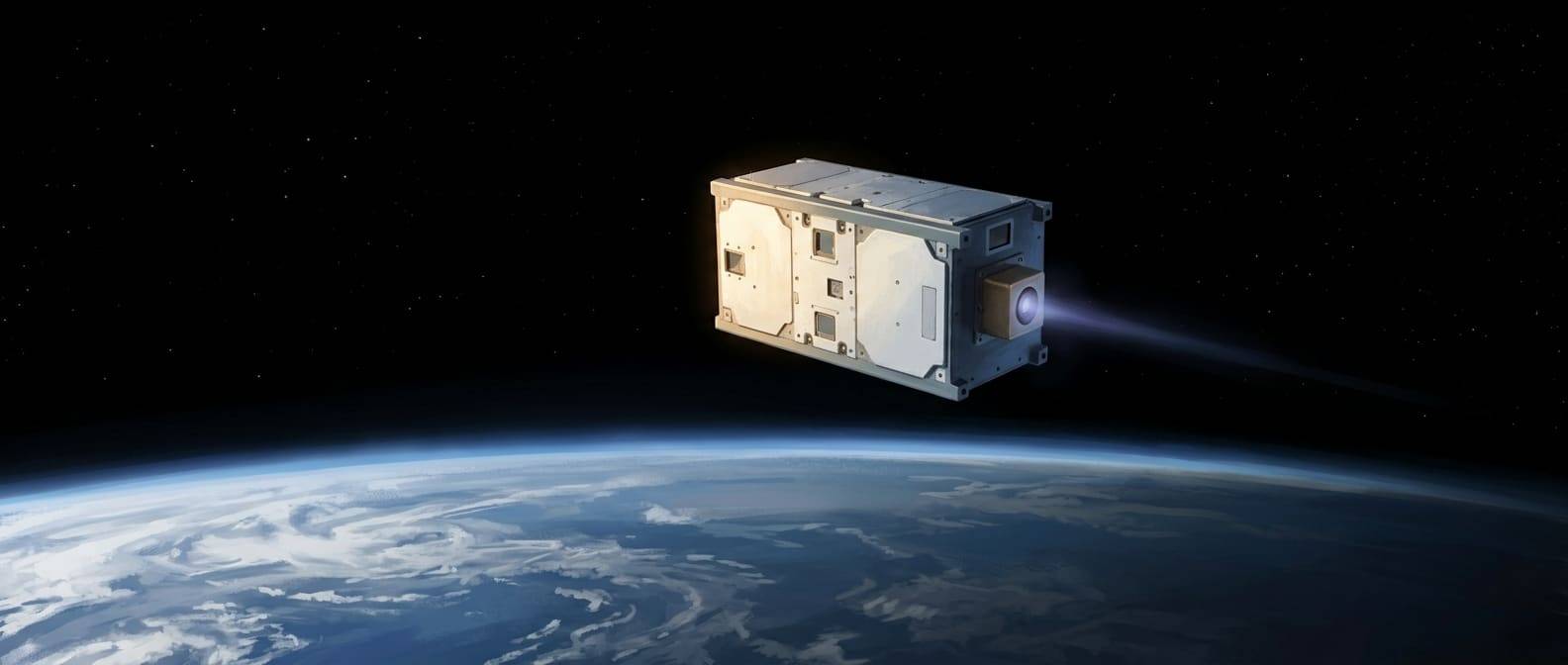
A mug-sized iodine thruster has already demonstrated its ability to change a small satellite's orbit, with independent tracking confirming the maneuver. Five years of flight data and commercial progress have established iodine as a credible option for efficient small-satellite propulsion. While modest thrust, warm-up times, and competition from established technologies remain challenges, upcoming higher-thrust demonstrations could further expand its potential. Iodine has moved beyond experimental technology into practical use, earning its place in the future of satellite propulsion without yet becoming the industry standard.
Picture a metal box roughly 10 centimeters on a side, weighing just 1.2 kilograms and packed with solid iodine, bolted inside a 20-kilogram satellite. In early 2021, radar tracking from Earth watched that satellite step upward into a higher orbit, gaining a few hundred meters every time the tiny box turned on. That burn was real. Five years of flight use and commercial orders have since made iodine a credible way for small satellites to maneuver. Modest thrust and a warm-up still set limits, and a higher-thrust version has not flown yet, but the propellant is already in practical use. That orbit change only makes sense once you understand why rocket engineers wanted to replace xenon in the first place.
Why Xenon Is a Difficult Fuel
Releasing a satellite into orbit is only the first step, because staying in the right spot requires an engine that can fire again and again over years. Electric thrusters are useless for launching off a launchpad because their push is miniscule, but they excel once a spacecraft is already in weightlessness because they sip fuel with extreme efficiency. For decades, xenon gas was the default choice for these engines because its heavy atoms strip down into ions easily. The trouble is that xenon is rare, expensive, and must be squeezed into heavy storage tanks at roughly 100 to 200 times normal atmospheric pressure. Loading those high-pressure tanks takes specialized ground equipment and strict safety measures.
Solid iodine solves that mechanical headache. Because iodine sits as a solid at room temperature, an engine can heat it gently to vaporize the chemical directly into a gas, a process known as sublimation, without needing a high-pressure tank. In their 2021 research paper in Nature, the thruster designers estimated that the raw iodine for a small engine cost about 60 dollars, compared to roughly 1,275 dollars for an equivalent mass of xenon, while the low-pressure fuel hardware cost nearly one hundred times less. Other options exist, including krypton gas, which SpaceX selected for early Starlink satellites to cut fuel costs. However, the same Nature study noted that krypton stores at about one-ninth the density of iodine and requires over 25 percent more electric power to generate the same thrust. Iodine is not the only substitute in space today, but its solid storage makes it far easier to handle on the ground. Easy handling does not make iodine harmless, however, as the element is chemically aggressive and will corrode standard satellite metals if not carefully isolated. A convenient tank design is helpful, but engineers still had to build an engine that would not destroy itself from the inside out.
Inside the Thruster
Containing a reactive element inside a miniature space engine required a design that turns solid iodine into a controlled plasma beam without using moving mechanical parts. Inside the 1.2 kg package, solid iodine rests within a porous block of aluminum oxide that is 95 percent open space.
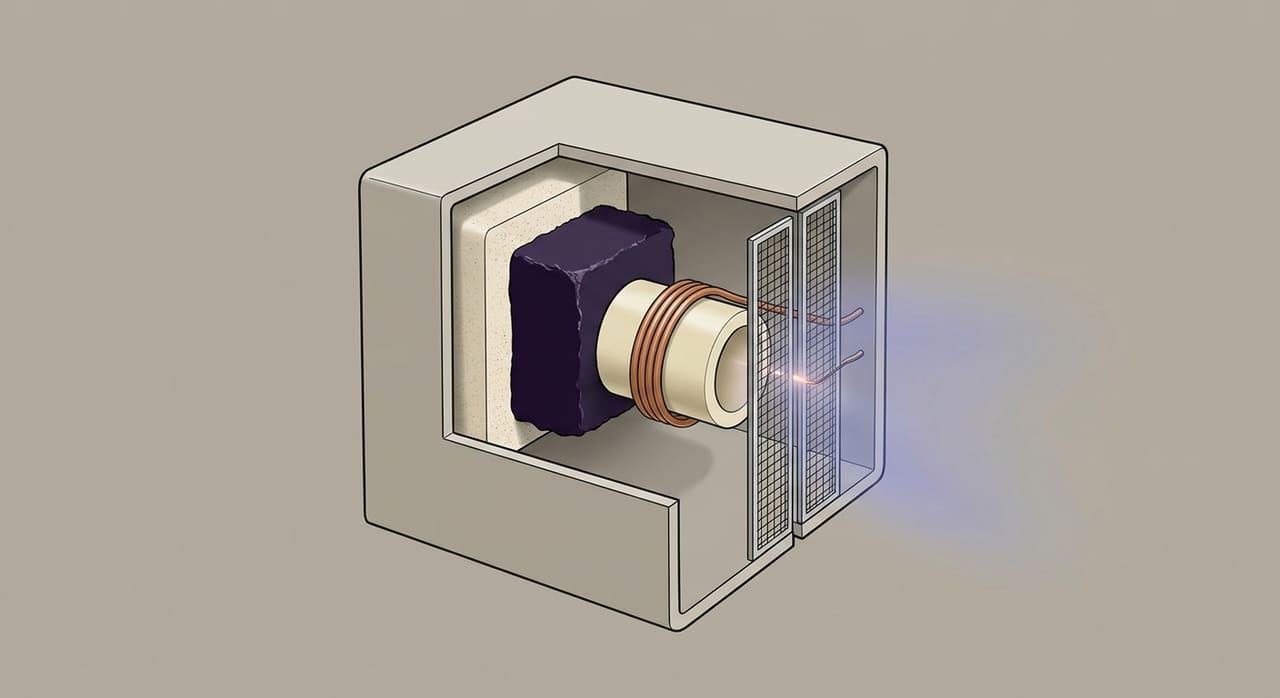
When the satellite prepares to maneuver, electric heaters raise the tank temperature to between 80 and 100 degrees Celsius, turning the solid directly into iodine vapor without melting it into a liquid. The gas flows into a technical ceramic tube where a radio-frequency antenna strips electrons off the molecules to form a plasma. Charged metal grids then accelerate those positive ions out of the back of the engine at roughly 40 kilometers per second. Outside the grids, two hot filaments made of carburized thoriated tungsten spray electrons into the exhaust so the spacecraft does not build up a static charge. The engine has no traditional fuel valve; when the heating stops, iodine vapor deposits in a microscopic orifice and naturally seals the flow. Starting from cold takes about 10 minutes, meaning this box cannot execute an instant emergency burn.
| Parameter | Value (Flown Unit Data) |
|---|---|
| Flight Thrust | ~0.8 mN at 55 W |
| Peak Map Thrust | ~1.3 mN (below 65 W) |
| Peak Specific Impulse | ~2,500 seconds |
| Total Impulse | 5,500 Ns (~1,500 hours) |
| Wet Mass | 1.2 kg |
| Dimensions | 96 x 96 x 106 mm |
| Propellant | Solid iodine ($I_2$) |
| Grid Voltage | 800 to 1,300 V |
| Exhaust Velocity | ~40 km/s |
Commercial catalog specs for the NPT30-I2 show slight tweaks, listing thrust from 0.3 to 1.1 millinewtons and specific impulse up to 2,400 seconds in a chassis a few millimeters longer. Those laboratory performance maps show what the design can reach under ideal ground conditions, which is distinct from how the machine performed during its first real flight in space. Internal metal parts were coated and ceramic tubes were used to shield the hardware from iodine corrosion. Ground testing proved the box could survive its own fuel, but proving it could move a real satellite required tracking data from orbit.
The Flight That Counted
Laboratory vacuum chambers can show how an engine runs, but actual orbital tracking is the only proof that a satellite moved as planned. On 6 November 2020, a Chinese Long March 6 rocket lifted off into a 480-kilometer circular sun-synchronous orbit, a pole-to-pole path where a satellite passes over any given spot at roughly the same local solar time. A company launch note recorded liftoff at 11:19 a.m. Beijing time from Taiyuan. The rocket carried Beihangkongshi-1, a 12-unit CubeSat weighing about 20 kilograms operated by Spacety, carrying U.S. Space Command catalog number 46838.
Between launch and 28 February 2021, the operational team fired the NPT30-I2 gridded ion thruster 11 times. Each maneuver lasted roughly 80 to 90 minutes, which included 10 to 20 minutes of initial warm-up time, operating at the baseline point of 0.8 millinewtons while drawing 55 watts of power. Each firing raised the satellite's altitude by 200 to 400 meters, accumulating over 3 kilometers of total orbit raising across the test campaign. Onboard GPS receivers with 20-meter precision recorded the climbs, and independent radar tracking from the U.S. Space Surveillance Network verified that the altitude steps matched the exact engine firing times. Those measured burns demonstrated that a tiny iodine thruster could handle routine satellite housekeeping, such as counteracting atmospheric drag in low Earth orbit (LEO) or adjusting orbits to prevent potential collisions. Because the system requires a 10-minute warm-up period, it is designed for planned orbital maintenance rather than last-second emergency evasions. With verified tracking data in hand, attention shifted to the team behind the technology and their next hardware developments.
Who Is Building It
Demonstrating a working prototype in orbit transformed a university research concept into an aerospace business. French propulsion company ThrustMe was founded in 2017 by Ane Aanesland and Dmytro Rafalskyi as a spin-out from CNRS and École Polytechnique, settling in Verrières-le-Buisson near Paris. The European Space Agency backed the early technology development through its ARTES telecom program. The company launched its hardware lineup with the NPT30-I2 gridded ion engine, the same basic architecture that moved the Chinese test satellite in 2020.
To offer higher thrust for larger maneuvers, the company began designing the JPT150, a low-power Hall thruster that uses a magnetic field to trap electrons and ionize iodine gas. In a 2025 conference abstract, engineers reported ground test results for an integrated prototype operating between 50 and 250 watts, producing 4 to 12 millinewtons of thrust with a specific impulse reaching 2,000 seconds. An early announcement in July 2025 referenced a 2026 orbital test on a satellite named MIRI, but an October 2026 update adjusted the timeline, confirming that qualification testing was complete and scheduling the first flight test for 2027 aboard Marble Sat-1, an Earth-observation satellite built by Reflex Aerospace for Marble Imaging. French government officials also highlighted the thruster technology at a Paris space summit in September 2026. While NASA Glenn research facilities have previously logged 1,174 hours on ground-based iodine Hall thrusters, an in-orbit flight of such an engine has yet to occur. Meanwhile, a broader French research study called IPISC, led by ONERA alongside ThrustMe and Airbus, is studying how iodine affects spacecraft materials larger than 500 kilograms over decade-long missions using the PICOMAX testing chamber. That study focuses on future heavy satellites, leaving current commercial adoption centered firmly on small spacecraft.
A Product, Not a One-Off
Expanding beyond a single experimental flight required building a standardized assembly line for commercial satellite fleets. In February 2025, trade publication SpaceNews reported company statements indicating that industrial production had begun in mid-2023, with over 150 thrusters delivered and 67 operating in orbit at that time. The report listed contract agreements with American space firms including Starfish Space, Astro Digital, Magellan Aerospace, Lumen Orbit, Oligo Space, Terran Orbital, and Turion Space, which scheduled a thruster on its DROID.002 craft for the Transporter-13 mission.
By 20 October 2026, SpaceX launched its Bandwagon-5 rideshare mission from Cape Canaveral, carrying 32 payloads into orbit. In a statement published two days later, ThrustMe announced that the launch pushed the total count of satellites equipped with its propulsion systems past 100. Satellite operators using or selecting these iodine engines span several continents: Munich-based OroraTech uses them on its FOREST wildfire surveillance satellites, Denmark's GomSpace integrates them for orbit raising and post-mission disposal, Astro Digital flies them on commercial platforms, while Japan's iQPS and India's PierSight and Dhruva Space have selected them for upcoming missions. The initial Chinese CubeSat demonstration has grown into a widespread commercial catalog, though exact hardware pricing remains undisclosed. Yet even with dozens of thrusters shipped across the globe, industry experts debate whether iodine will completely eclipse rival propellants.
Not the Default Yet
Widespread adoption across commercial constellations demonstrates strong momentum, but converting an industry standard requires overcoming key operational limits. The argument for iodine rests on solid physical advantages: unpressurized propellant tanks simplify satellite assembly, orbital tracking confirms reliable burns, and small thrusters fit the exact operational needs of CubeSats needing drag makeup or orbital disposal. New space sustainability rules make onboard propulsion increasingly necessary. The U.S. Federal Communications Commission requires licensed LEO satellites to re-enter the atmosphere within five years of ending their missions, while French space regulations enforce strict orbital decay rules for unpowered satellites above 600 kilometers, and proposed European Union legislation outlines maneuvering mandates above 400 kilometers.
Despite these regulatory tailwinds, iodine has not entirely replaced traditional gases. Producing only around one millinewton of thrust means maneuvers take days or weeks of incremental burns rather than swift orbital adjustments, while the 10-minute warm-up cycle limits rapid responses. While internal ceramic shielding protects the engine itself, satellite builders remain cautious about whether condensed iodine plumes could degrade delicate sensors or solar arrays over multi-year operations. Xenon and krypton tanks continue to fly on major commercial constellations, and ThrustMe's fleet count of over 100 satellites relies on company announcements rather than independent satellite manifests. Higher-thrust iodine engines like the JPT150 remain ground-tested prototypes awaiting their 2027 flight on Marble Sat-1. Until high-thrust iodine engines prove themselves in space, noble gas systems will remain strong contenders for small satellite fleets.
A Candidate, Not the Winner
Five years of flight data and commercial deployments reveal a technology that has earned a permanent place in satellite design without rendering its competitors obsolete. For small satellites requiring efficient orbital adjustments, solid iodine has successfully moved out of the laboratory. A 1.2-kilogram system demonstrated verifiable orbital changes on a 20-kilogram satellite, and by late 2026, iodine propulsion has become a standard catalog option for small-sat manufacturers.
Yet iodine is not a universal solution. Thrust remains modest, warm-up times preclude rapid evasive maneuvers, traditional noble gases remain deeply entrenched, and fleet-wide statistics still lean heavily on manufacturer reporting. The next test comes with the scheduled 2027 orbital debut of higher-thrust hardware aboard Marble Sat-1. Solid iodine has proven it is a viable path for small-satellite propulsion, but until higher-thrust units fire in orbit and long-term flight data is fully open, it remains a strong candidate, not an undisputed winner.
Subscribe to Apogee Log
Get deep-tech intelligence updates and featured analytical reports delivered to your inbox.