ESCAPADE: The Inside Story of NASA's Twin Mars Satellites
Space & Aerospace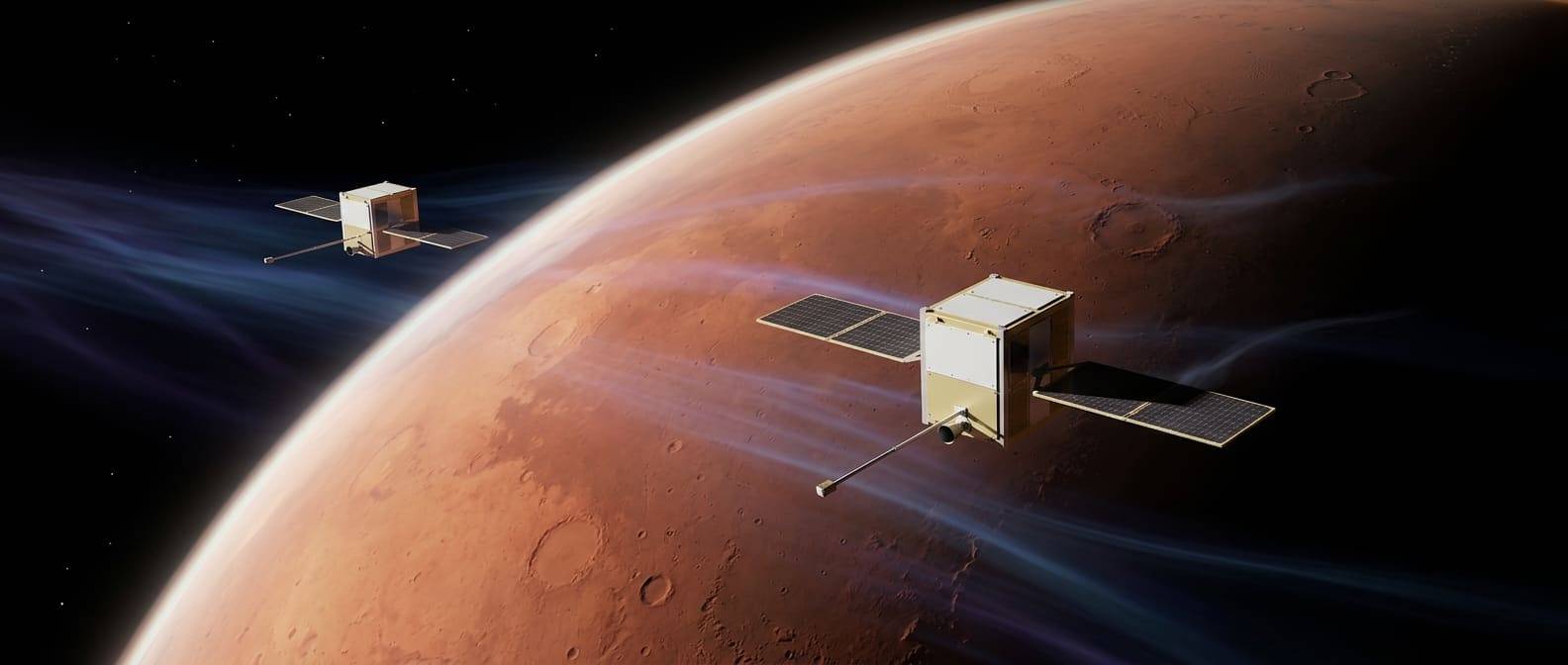
NASA's ESCAPADE mission sent two identical satellites, Blue and Gold, toward Mars on a single rocket. One launch vehicle got them off Earth. The two satellites, each with its own small engine, are there to watch how the planet loses its air.
A Tale of Two Satellites: Why NASA Is Sending Twins to Mars
When NASA committed to the ESCAPADE mission, the engineering requirement was non-negotiable: one rocket, two identical spacecraft. Named Blue and Gold in honor of the University of California, Berkeley team leading the science, both orbiters lifted off on November 13, 2025, stacked inside the payload fairing of Blue Origin's New Glenn launch vehicle. Roughly thirty minutes after ignition, the upper stage completed its primary task and separated, handing operational command over to the twin satellites.
The scientific objective driving this architecture addresses a long-standing planetary mystery. Geological evidence proves that ancient Mars once maintained a dense atmosphere capable of supporting liquid water on its surface. Today, the vast majority of that atmosphere has escaped into space, stripped away over billions of years by solar wind interactions.
Single-spacecraft missions face an inherent measurement bottleneck when profiling this atmospheric decay. A lone orbiter taking readings at point A and then moving to point B hours later cannot determine if a sudden fluctuation in plasma density was caused by a transient solar flare or localized planetary conditions. By deploying twin satellites into coordinated, offset orbits, ESCAPADE can sample two distinct regions of the Martian magnetosphere simultaneously, finally decoupling space weather variables from localized atmospheric response.
Mars Wasn't Always the Cold, Dry Planet We See Today
Today, Mars is a cold, dry world with a very thin atmosphere. The air pressure on its surface is less than one percent of Earth's. But evidence from Mars rovers and orbiters tells a very different story about its past. Scientists have found ancient river valleys, lake beds and minerals that could only have formed in the presence of water. Billions of years ago, Mars was likely much warmer and wetter than it is today.
So what happened? One important part of the answer may lie in the planet's atmosphere.
A thicker atmosphere helps keep a planet warm and allows liquid water to exist on its surface. As Mars lost much of its atmosphere, its surface became colder and less suitable for liquid water. Scientists believe the solar wind played an important role in this process.
The solar wind is a continuous stream of charged particles released by the Sun. When these particles reach Mars, they interact with the planet's upper atmosphere. Some particles can knock atmospheric gases into space, gradually reducing the amount of atmosphere Mars retains.
Earth is better protected because it has a strong global magnetic field generated by movement inside its molten core. This magnetic field helps shield our planet from the solar wind. Mars once had a similar global magnetic field, but it weakened and eventually disappeared.
Today, Mars still has small regions of magnetism preserved in its crust. It also has a magnetic environment created by the interaction between the solar wind and its upper atmosphere. Scientists call this a hybrid magnetosphere.
Even now, atmospheric particles continue to escape from Mars into space. The process is slow, but over billions of years, it may have played a major role in transforming the planet from a warmer, wetter world into the cold desert we see today.
Understanding exactly how this process works is one of the main goals of NASA's ESCAPADE mission. By using two satellites to observe the solar wind and Mars' magnetic environment, scientists hope to better understand how and why the planet continues to lose its atmosphere.
What Exactly Is ESCAPADE?
ESCAPADE stands for Escape and Plasma Acceleration and Dynamics Explorers. The name reflects what the mission aims to study: how Mars loses particles from its atmosphere and how charged particles move and interact around the planet.
To understand the mission, it helps to know what these terms mean. Atmospheric escape refers to gases and particles leaving a planet and moving into space. Plasma is a gas made up of charged particles, such as electrons and ions. The solar wind is one example of plasma. ESCAPADE will study how these particles move, interact with Mars' magnetic environment and contribute to atmospheric loss.
NASA is funding the mission through its Heliophysics Division, which studies the Sun and its effects throughout the solar system. ESCAPADE is also part of NASA's SIMPLEx (Small Innovative Missions for Planetary Exploration) program. This program supports smaller, lower-cost missions that explore new approaches to planetary science.
The mission is led by the University of California, Berkeley's Space Sciences Laboratory, with Rob Lillis serving as principal investigator. The project has a budget of less than $80 million, making it a relatively low-cost approach to exploring Mars.
Several organizations have contributed to building and operating the mission:
- Rocket Lab: Built both spacecraft using its Explorer platform.
- Advanced Space: Designed the trajectory from Earth to Mars.
- Blue Origin: Provided the New Glenn launch vehicle.
- NASA's Goddard Space Flight Center: Developed the magnetometers that measure magnetic fields.
- Embry-Riddle Aeronautical University: Built the Langmuir probes to study charged particles around the spacecraft.
- Northern Arizona University: Contributed visible-light and infrared cameras.
What makes ESCAPADE different from many earlier Mars missions is its approach. Rather than relying on a single spacecraft, it uses two identical satellites that work together to study Mars from different positions. Its unconventional journey to Mars also demonstrates a different way of planning interplanetary missions, without depending entirely on the traditional launch window that comes around every 26 months.
Why Two Satellites? The Science Behind the Twin Mission
A single satellite can only observe one location at a time. It collects data as it travels around Mars, but when it returns to the same region, hours may have passed. During that time, the solar wind could have changed, or Mars may have rotated, bringing a different part of the planet into view. This makes it difficult for scientists to know whether a change in their measurements comes from changing conditions over time or from differences between locations.
ESCAPADE uses two satellites to overcome this limitation. Instead of simply repeating the same observations, the spacecraft can work together in two different formations, each designed to answer a different scientific question.
First, they will fly in the same orbit, one behind the other. The satellites will pass through the same region of space a few minutes apart. By comparing their measurements, scientists can see whether conditions remained stable or changed between the two observations. This helps them understand how Mars' space environment changes over time.
Later, they will move into different orbits to observe separate regions simultaneously. One satellite will travel farther from Mars, where it can measure the incoming solar wind before it reaches the planet. The other will stay closer to Mars, observing how the planet's magnetic environment responds. Comparing these measurements will help scientists understand how solar wind interacts with Mars and contributes to the loss of atmospheric particles.
Both spacecraft, named Blue and Gold, carry identical scientific instruments. Neither is simply a backup for the other. Their ability to operate independently and collect measurements from different locations is central to the mission.
The advantage is simple: one satellite can show scientists what is happening in one place. Two satellites can help explain how conditions change over time and how events in different regions are connected.
Inside the Spacecraft: The Technology Behind ESCAPADE
| Each of Blue and Gold | Source | |
|---|---|---|
| Builder | Rocket Lab, Long Beach, on its Explorer platform | Rocket Lab |
| Mission lead | UC Berkeley Space Sciences Laboratory | NASA |
| Dry mass | 209 kg (460 lb) | NASA |
| Fueled mass | 535 kg (1,179 lb) | NASA |
| Stowed size | 1.20 x 1.65 x 1.09 m | NASA fact sheet and Rocket Lab |
| Deployed size | 4.88 x 1.65 x 1.09 m, arrays open | NASA fact sheet and Rocket Lab |
| Main engine | Hypergolic bipropellant: mixed oxides of nitrogen and monomethylhydrazine. The two liquids ignite on contact | Rocket Lab |
| Steering thrusters | Cold nitrogen gas, for pointing and small moves | Rocket Lab |
| Tanks | 2 fuel, 2 oxidizer, 2 helium pressurant, 4 nitrogen | Rocket Lab |
| Science power draw | 128 W | Rocket Lab |
| Power generated near Earth | 800 W | Rocket Lab |
| Power generated at Mars | 288 W when Mars is farthest from the Sun | Rocket Lab |
| Batteries | Five battery packs | Rocket Lab |
| Guidance | 2 star trackers, 4 fine sun sensors, 4 reaction wheels | Rocket Lab |
| Computers | Redundant flight computers | Rocket Lab |
| Radios | Redundant X-band radios (Frontier-X) | Rocket Lab |
| Antennas | 4 low-gain, 2 medium-gain, 1 high-gain | Rocket Lab |
| Science data planned | 45 gigabits downlinked | Rocket Lab |
| Magnetometer | At the tip of a 2 m boom. Measures the magnetic field around the satellite | NASA Goddard |
| Electrostatic analyzers | Electrons and ions, sorted by energy | UC Berkeley |
| Langmuir probes | Density of the colder plasma, and how electrically charged the spacecraft is. The multi-needle probe rides on the boom | Embry-Riddle |
| Cameras | Student-built visible camera and thermal infrared camera, for views of Mars | Northern Arizona University |
| Boom and instrument electronics | Boom, data processor, and instrument control board | UC Berkeley |
Getting to Mars: A Journey That Didn't Follow the Usual Route
Most missions to Mars follow a carefully planned route that takes advantage of the positions of Earth and Mars. The two planets align favorably for this journey roughly every 26 months, creating a launch window that allows spacecraft to travel with less fuel. Once launched, the trip usually takes between seven and eleven months.
ESCAPADE was originally scheduled to launch in fall 2024, taking advantage of this opportunity aboard the first flight of Blue Origin's New Glenn rocket. However, when the launch was delayed beyond that window, the mission needed a different plan.
Instead of waiting another two years for the next conventional launch window, the team developed an alternative route.
The new journey began at Lagrange Point 2 (L2), a region about 1.5 million kilometers (one million miles) from Earth, on the opposite side of Earth from the Sun. At this location, the gravitational forces of the Sun and Earth allow a spacecraft to maintain a relatively stable orbit with limited fuel.
After launching in November 2025, ESCAPADE's two satellites, Blue and Gold, entered a large looping orbit around this region. They remained there while waiting for Earth and Mars to reach a favorable position for the next part of their journey.
In November 2026, the satellites performed a powered Earth flyby to begin their journey toward Mars.
This approach offers an interesting alternative for future space missions. Instead of depending entirely on a narrow launch window every two years, spacecraft could launch when a rocket is available, wait in space and begin their journey to another planet when the timing is right.
The Earth Flyby: The Maneuver That Set ESCAPADE on Its Way to Mars
A year after launch, the waiting room worked. Each satellite swung back past Earth and fired its engine at the closest point.
Blue came first, on the morning of 7 November 2026, about 1,000 miles above the surface. The burn lasted about nine minutes. Gold followed at about 6 a.m. Eastern on 9 November, about 650 miles up, for about the same length of time. NASA's heliophysics division said both burns went as planned.
The trick is a gravity assist with the engine added in. A planet's gravity bends a passing spacecraft's path and can lend it speed. Firing the engine deep in that gravity well changes the speed more than the same firing would far from Earth, because the spacecraft is already moving quickly. NASA calls the combination a powered flyby, and says this is the first time the agency has used one to send spacecraft toward Mars. Doing it twice, two days apart, put Blue and Gold on matching roads instead of leaving one behind.
They are no longer orbiting near Earth. The ten-month cruise to Mars is the part they are in now.
The Road Ahead: What Happens Before ESCAPADE Reaches Mars?
The journey to Mars will involve more than simply traveling through space. During the cruise, the spacecraft will make small adjustments to stay on the correct path. These adjustments, known as trajectory correction maneuvers, help ensure that both satellites reach Mars at the planned time and position.
Mission controllers at UC Berkeley will monitor the spacecraft, checking their communication systems, power levels and scientific instruments. The satellites have already had an opportunity to test their equipment during their time near Earth. They passed through Earth's magnetotail, a region of Earth's magnetic environment that stretches away from the Sun, and collected scientific data along the way.
ESCAPADE's arrival at Mars is planned in two stages. NASA expects the first satellite to arrive on September 7, 2027, followed by the second on September 9. Each spacecraft will fire its main engine for approximately 11 minutes to slow down and enter Mars orbit. This process is called Mars orbit insertion.
However, the initial orbits will not be suitable for scientific observations. Over the following months, the mission team will gradually adjust the spacecraft's orbits to prepare them for their science operations.
This process also needs to account for an event called solar conjunction. During this period, Mars will pass behind the Sun from Earth's perspective. The Sun can interfere with radio signals between Earth and the spacecraft, making communication difficult. Mission controllers will therefore need to complete important orbital adjustments before this period.
After solar conjunction, the satellites will make further adjustments to reach their final science orbits. By around the middle of 2028, both spacecraft are expected to be ready to begin their planned observations.
Reaching Mars is an important milestone, but it is only the beginning. The mission's main scientific work will start once both satellites are in position and ready to study the planet together.
How ESCAPADE Will Study Mars: Two Satellites, Two Science Campaigns
Once the satellites reach Mars, they are expected to spend about 11 months conducting scientific observations. During this time, they will study the space environment around the planet, flying at different distances ranging from roughly 160 km to 10,000 km above the surface.
The mission has two main phases of scientific observations. Each uses the two satellites in a different formation to help scientists understand how Mars interacts with the solar wind.
Tracking Changes Around Mars Over Time
The first phase will last approximately six months. Both satellites will follow the same orbit, with one trailing behind the other.
The distance between the spacecraft will be adjusted several times during this phase, allowing scientists to compare measurements taken at different intervals.
The goal is to understand how conditions around Mars change over time. As the first satellite passes through a region, it records the surrounding plasma and magnetic field. The second satellite then passes through the same region a short time later.
By comparing their readings, scientists can determine whether conditions remained stable or changed between the two observations.
This is important because a single satellite would have to wait until its next orbit to observe the same region again. By then, changes in the solar wind or Mars' rotation could affect the measurements.
Watching Mars Respond to the Solar Wind
The second phase will last approximately five months. This time, the satellites will move into separate orbits so they can observe different regions around Mars simultaneously.
One satellite will travel farther from the planet, where it can measure the incoming solar wind before it reaches Mars. The other will remain closer to the planet, observing how the solar wind interacts with Mars' magnetic environment, known as the hybrid magnetosphere.
This formation allows scientists to compare what is happening outside the planet's magnetic environment with how Mars responds to it.
For example, if the outer satellite detects a sudden increase in solar wind activity, scientists can compare that observation with measurements from the inner satellite to see how Mars responds.
Together, the two phases will give scientists a more complete picture of how solar wind interacts with Mars and how this interaction contributes to the loss of its atmosphere.
What Could ESCAPADE Reveal About Mars and Future Human Exploration?
By using two satellites, ESCAPADE will give scientists a better understanding of how energy and particles move around Mars. They will be able to track where the solar wind interacts with the planet, how magnetic fields guide charged particles and where particles from the upper atmosphere escape into space. These observations can help separate changes that happen over a short period from patterns that persist over time.
The findings will also add to what scientists already know about Mars. NASA's MAVEN mission has been studying the planet's upper atmosphere and its loss to space since 2014. ESCAPADE will complement those observations by measuring conditions from two locations at once. Together, the missions could help scientists build a clearer picture of how the solar wind contributes to atmospheric escape.
This research could also help explain how Mars changed from a planet that once had rivers and lakes into the cold, dry world we see today. ESCAPADE will not directly investigate ancient rivers or climate conditions. Instead, it will study the processes that can gradually remove an atmosphere and examine how Mars' uneven magnetic environment influences that loss. Understanding these processes may also help scientists study how other planets, including those orbiting distant stars, evolve over time.
The findings could matter for future human missions as well. Astronauts on Mars will be exposed to the same space environment that ESCAPADE is designed to study. Solar activity can affect the planet's upper atmosphere, while charged particles and changes in the ionosphere, the electrically charged region high above the surface, can interfere with radio signals and communications. A better understanding of these conditions could help mission planners assess potential risks and prepare more reliable communication and navigation systems for future explorers.
Two Small Satellites, One Big Question: What Makes ESCAPADE Matter?
Mars did not lose its atmosphere overnight. It was a gradual process that unfolded over billions of years, and the solar wind may have played a major role. ESCAPADE gives scientists a new way to study that process. By observing Mars from two locations, Blue and Gold can help reveal how the solar wind transfers energy to the planet's magnetic environment and carries particles away from its upper atmosphere.
The mission is also a reminder that exploring another planet does not always require a large spacecraft or a billion-dollar mission. New Glenn delivered the two satellites to space, but the real work belongs to Blue and Gold. Flying independently, yet working together, they will collect measurements that a single spacecraft could not provide in the same way. Their journey, from launch to the planned arrival at Mars in September 2027 and the start of science operations in 2028, is itself an example of a different approach to interplanetary exploration.
ESCAPADE will not solve every mystery about Mars, and it cannot recreate the planet's entire climate history. But it can help answer a fundamental question: how does a planet lose the atmosphere that once helped make it a very different world?
That question reaches beyond Mars. It helps us understand how planets evolve, what makes some worlds more capable of retaining an atmosphere than others, and what conditions future explorers may face. Two small satellites are heading to Mars to study an enormous transformation. What they discover could change how we understand not only the planet Mars became, but also the worlds that might one day be home to life.
Subscribe to Apogee Log
Get deep-tech intelligence updates and featured analytical reports delivered to your inbox.